




BPC-157: The Body’s Own Healing Peptide - and Why the World Can’t Ignore It
Table Of Content
What if healing wasn’t just faster, but smarter?

BPC-157: The Body’s Own Healing Peptide - and Why the World Can’t Ignore It

iThrive Team
May 20, 2026

Introduction 

What if the body already had a "repair switch”?

Imagine tearing your tendon, injuring a ligament or damaging muscle tissue. Healing can take months. What if your body had accelerated self-repair mechanisms? This concept has athletes and researchers alike drooling over BPC-157. Isolated from human gastric juice in 1993 by Croatian researcher Predrag Sikiric, BPC-157 completely astonished researchers when used in animal experiments. Tendons, ligaments, muscles, nerves, bones, teeth, corneas, and blood vessels have all been demonstrated to heal faster when BPC-157 is introduced. Some studies also suggest it may:

  • protect the liver,
  • support recovery after traumatic brain injury,
  • improve blood vessel stability,
  • and influence clot formation and breakdown.

Sounds almost too good to be

true?

That’s where things get

interesting.

So… How Does BPC-157 Actually Work?

Instead of acting through a

single pathway, BPC-157 appears to influence multiple repair systems

simultaneously - almost like coordinating a biological “repair network.”

How BPC-157 Works: A Multi-System Repair Network

1. It Helps Build New Blood - Vessels

One of the peptide’s most studied effects is angiogenesis - the formation of new blood vessels.

BPC-157 enhances VEGFR2 activity and activates the Akt-eNOS pathway, increasing nitric oxide (NO) production.

This matters because nitric oxide helps:

  • dilate blood vessels,
  • improve circulation,
  • support endothelial function,
  • and deliver oxygen and nutrients to injured tissues.

This may be especially important in poorly vascularized tissues like tendons and ligaments, which normally heal very slowly.

2. It May Calm Inflammation Without Stopping Healing

Inflammation is necessary after injury - but excessive inflammation can delay recovery and increase fibrosis.

Studies suggest BPC-157 reduces several pro-inflammatory cytokines including:

  • TNF-α,
  • IL-6,
  • and IFN-γ.

Interestingly, it also appears to shift macrophages from the inflammatory “M1” state toward the reparative “M2” state, potentially creating an environment more favorable for tissue regeneration.

3. It May Protect the Nervous System

Some experimental models suggest BPC-157 can normalize glutamatergic signalling and counteract NMDA receptor overactivation.

In simpler terms: it may help stabilize communication between neurons after injury or chemical stress.

Researchers observed protective effects against neurotoxic agents such as ketamine and MK-801, suggesting possible roles in neural recovery and synaptic repair.

Why Are Tendons and Ligaments So Important Here?

Tendons and ligaments are notoriously slow to heal because they receive limited blood supply.

That’s why BPC-157 has attracted so much attention in sports medicine research.

Studies suggest the peptide:

  • increases fibroblast activity,
  • enhances collagen synthesis,
  • activates FAK-paxillin signalling,
  • And improves biomechanical strength during recovery.

Even under compromised conditions

  • such as corticosteroid exposure or poor vascular supply -BPC-157 appeared to improve tendon organization and healing quality in animal models.

Can It Help Bones Heal Too?

Possibly.

Preclinical studies suggest BPC-157 may stimulate osteogenesis (bone formation) and accelerate fracture healing.

Researchers observed improved:

  • osteoblast activity,
  • angiogenesis within bone tissue,
  • bone matrix deposition,
  • and fracture consolidation.

This has sparked interest in whether the peptide could eventually play a role in difficult orthopaedic conditions like delayed unions or avascular osteonecrosis.

Why Are Scientists So Interested in the Endothelium?

The endothelium - the thin inner lining of blood vessels - plays a central role in healing.

BPC-157 activates the ERK1/2 signalling pathway, increasing:

  • endothelial proliferation,
  • cellular migration,
  • and vascular tube formation.

These effects support tissue regeneration by improving vascular stability and repair signalling.

In simple terms: better blood vessel function often means better healing.
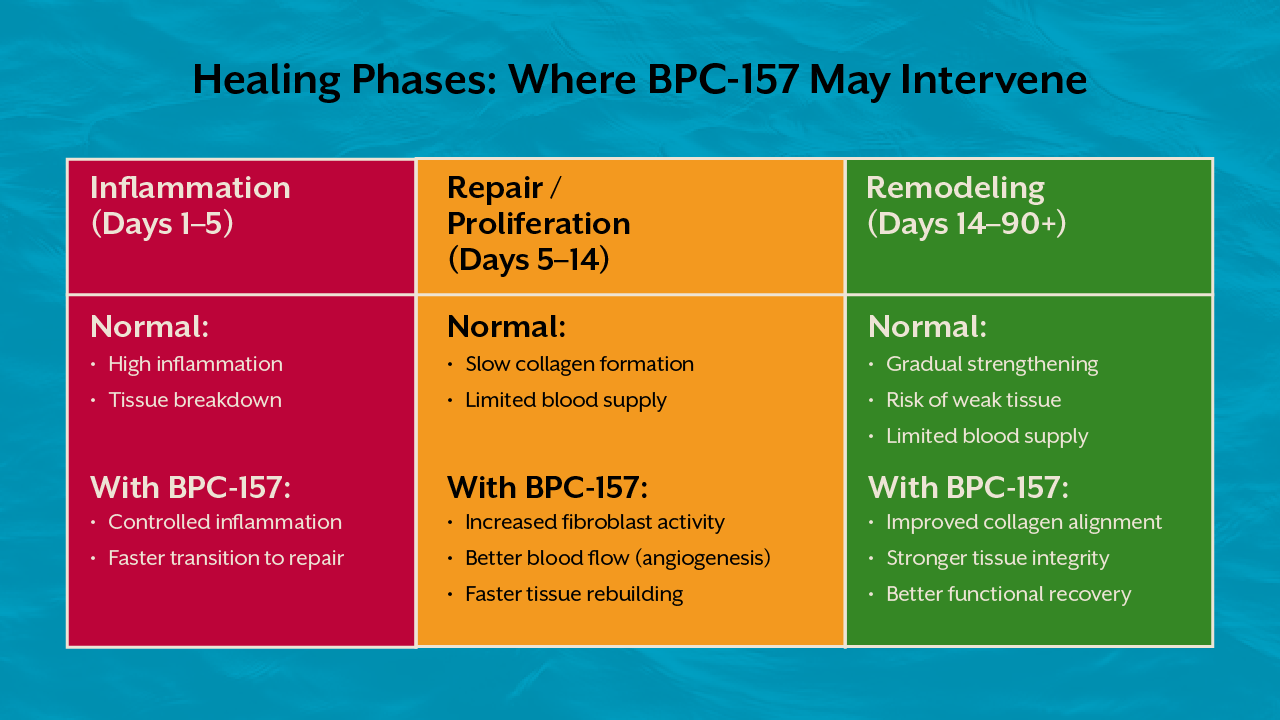
Healing Phases: Where BPC-157 May Intervene

Healing Happens in Phases - and BPC-157 May Influence All of Them

Normally, tissue healing occurs in three stages:

Phase 1: Inflammation (Days 1-5)

Immune cells rush to the injury site.

Phase 2: Repair/Proliferation (Days 5-14)

Fibroblasts produce collagen and rebuild tissue.

Phase 3: Remodeling (Days 14-90+)

Tissues strengthen, reorganize, and mature.

BPC-157 appears to interact with several processes across all three phases, particularly in tissues with poor blood supply.

That broad activity is one reason the peptide continues to attract attention in regenerative medicine research.

What Does BPC-157 Actually Look Like?

At first glance, the structure of BPC-157 may look like a random chain of letters. But each of those letters represents an amino acid - the molecular “building blocks” used to construct proteins and peptides throughout the body.

The sequence shown above forms a short peptide linkage made up of 15 amino acids:

Gly-Glu-Pro-Pro-Pro-Gly-Lys-Pro-Ala-Asp-Asp-Ala-Gly-Leu-Val

This specific arrangement is believed to be critical to BPC-157’s biological activity. Interestingly, the peptide is derived from a naturally occurring protective protein found in human gastric juice, which may explain why researchers initially became interested in its potential role in tissue protection and repair.

The abundance of proline (Pro) residues in the sequence may also contribute to its structural stability and regenerative properties, particularly in connective tissue healing where collagen and extracellular matrix organization are essential.

In simple terms, this tiny chain of amino acids may act less like a traditional drug and more like a molecular “repair signal” that helps coordinate healing pathways throughout the body.

So… Is BPC-157 the Future of Healing?

Maybe - but the science is not settled yet.

Animal studies consistently show promising regenerative, angiogenic, anti-inflammatory, and cytoprotective effects. A small human pilot study also suggested the compound was well tolerated. 

If you’re exploring peptides like BPC-157, it’s also worth understanding how they compare to bioregulators-read this for a clearer perspective: https://www.ithrive.academy/blogs/bioregulators-vs-peptides-how-to-choose

A
Ask your doubts
Thank you! Your submission has been received!
Oops! Something went wrong while submitting the form.

FAQs

What is BPC-157 and where does it come from?
faq arrow

BPC-157 is a synthetic peptide derived from a protective protein found in human gastric juice. It has gained attention for its potential role in tissue repair and regeneration in preclinical studies.

How does BPC-157 support healing in the body?
faq arrow

It appears to influence multiple pathways including blood vessel formation, inflammation control, and collagen synthesis. This coordinated effect may help improve healing, especially in tissues with poor blood supply.

Can BPC-157 help with tendon and ligament injuries?
faq arrow

Animal studies suggest it may enhance fibroblast activity, collagen production, and overall tissue strength during recovery. However, robust human clinical evidence is still limited.

Does BPC-157 have effects beyond physical injury repair?
faq arrow

Some research indicates it may support liver health, protect the nervous system, and stabilize blood vessels. These effects are still being explored and are not yet fully established in humans.

Is BPC-157 safe for human use?
faq arrow

Current evidence is mostly based on animal studies, with very limited human data available. While early findings suggest it may be well tolerated, more research is needed to confirm its safety and effectiveness.

Related Blogs

How Retatrutide Works: The Molecular Mechanism Behind the Most Powerful Weight Loss Peptide Yet
read count
read time
May 20, 2026

How Retatrutide Works: The Molecular Mechanism Behind the Most Powerful Weight Loss Peptide Yet

Retatrutide is redefining weight loss with its triple hormone action. This blog breaks down how it works, why it’s more effective than older peptides, and what it reveals about the biology behind fat loss and metabolism.

Introduction

Struggling with your weight? Tired of trying everything to get rid of your stubborn fat? Despite your best efforts, you just can’t lose weight. If you have ever felt this way, believe me, you are not alone. For years, we have been told weight loss is simply a matter of willpower and discipline. Eat less. Exercise daily. Strictly follow a diet. But that narrative is finally starting to shift. Over the past few years, a new class of medications have changed the conversation around obesity. You may have heard about peptides - semaglutide (Ozempic) or tirzepatide (Mounjaro). Now, there is a new peptide that is even more effective - Retatrutide.

Early weight loss results from clinical trials have stunned researchers. Subjects lost up to 24% of their body weight in less than a year. That is more than double what most weight loss drugs could accomplish. And for the first time, it actually worked long-term.

But how does retatrutide work? For this, we need to take a deeper look. In order to understand how this peptide works, we first need to understand why weight loss is so tough in the first place. Your body does not want to lose weight. You may feel like you need to lose weight, but your body might not agree. Don’t blame yourself if this is you. Your body is naturally programmed to maintain its current fat stores. This is why when you go on a diet, your body fights you. When you try to shed those extra pounds, hunger signals kick in and your metabolic rate slows down. It’s not your fault, this is just biology. So what hormones are we talking about here? GLP-1, GIP and glucagon are the big players. Each of these signal hunger, fullness, blood sugar levels, and fat burning to your brain and body in different ways. Most weight loss peptides target one or some combination of these pathways. Retatrutide hits all three at once.

What is Retatrudite?

Retatrutide is a novel triple receptor agonist developed by Eli Lilly and Company that supports weight loss, improves glycemic control and also provides cardiovascular benefits. It is basically a peptide that binds to three different hormone receptors in our body. When we take it, this peptide works by activating the following receptors.

  • GLP-1 (Glucagon-Like Peptide-1) Receptor
  • GIP (Glucose-Dependent Insulinotropic Polypeptide) Receptor
  • Glucagon Receptor

You can think of your weight management system as a fancy security system with three locks on it. Every other peptide in this class can only unlock 1. Retatrutide unlocks them all at the same time.

If you’re curious about how peptides compare to other emerging therapies, you can read more about it here: https://www.ithrive.academy/blogs/bioregulators-vs-peptides-how-to-choose

How Retatrutide Works: 3 Hormones, 1 Powerful Outcome

What is the mechanism of action of Retatrutide?

Retatrutide acts as a triple receptor agonist, simultaneously targeting the three receptors that play crucial roles in metabolic regulation.

The GLP-1 hormone is naturally released by the intestines when we eat food. GLP-1 does a few different things. For starters, it causes the pancreas to release insulin and lower our blood sugar. It also slows down the rate at which food leaves your stomach. This is great for weight loss because it keeps food in your stomach longer, making you feel more satiated. But most importantly, GLP-1 sends a signal to your brain that you are full.

When someone is obese, this signal may not be as strong as it needs to be. You feel hungry so you eat, but your body doesn’t send the “I’m full now” signal properly, or it takes too long to send. As a result, you consume more food than your body actually needs. But when you take retatrutide, it activates GLP-1 receptors. It supercharges your body’s “I’m full” signal. Your body gets the message that you’re full clearly and quickly. Food takes longer to process, so you feel fuller after meals. You end up eating less naturally, without forcing yourself to do so. This mechanism is how peptides like semaglutide and tirzepatide work. But again, retatrutide targets GLP-1 receptors as well as GIP receptors

The GIP hormone works extremely similarly to GLP-1. Like GLP-1, it’s also released from your intestines when you eat. On its own, activating GIP won’t do much for you. But studies have shown that the simultaneous activation of GIP and GLP-1 causes something called synergism. Essentially, GLP-1 and GIP communicate with each other. When both are activated at the same time by retatrutide, they send each other stronger signals. The brain is better able to receive GLP-1’s full signal and as a result, you feel fuller faster and for longer.

Research has also indicated that GIP signals fat cells directly, though more research is needed to understand this effect. It’s the exact same reason why tirzepatide (GLP-1 and GIP dual agonist) works better than semaglutide (GLP-1 agonist only). Retatrutide just adds to it by activating the glucagon receptor too.

Glucagon is a hormone we usually think of as doing the opposite of weight loss medications- it raises blood sugar. But it turns out that if glucagon activation is precisely calibrated with GLP-1 and GIP activation, it provides incredible benefits. By itself, glucagon ramps up energy expenditure. It signals the liver to burn more fat and independently decreases appetite from GLP-1. Together, these effects give retatrutide an extra edge for appetite suppression. Researchers realized that if GLP-1 is simultaneously activated while also turning on glucagon, the GLP-1 effects will blunt the blood sugar-increasing properties of glucagon while allowing everything else to persist. You get increased calorie burning and appetite suppression without the side effects. GLP-1, GIP and glucagon are hence synergistic.

Your Body vs Your Goals: What’s Actually Happening

What happens in your brain on Retatrutide?

Most people think of peptides as working on the stomach. They also work on metabolism. But they work predominantly in the brain. The frontal hunger centre of the brain is called the hypothalamus. That’s where GLP-1, GIP and glucagon are sending most of their signals to reduce hunger and increase energy expenditure. As more and more satiety inputs hit the hypothalamus from retatrutide, the brain stops perceiving hunger. GLP-1 also works on the brain’s reward centres. Activation of this receptor can reduce food cravings, particularly high-fat and high-sugar foods. Many people describe how food just isn’t as appealing while they are on these peptides. This isn’t caused by misery or deprivation, either. There is actual evidence showing that food rewards are genuinely less satisfying. If you have spent any length of time struggling with obesity, having your brain stop obsessing about food can seem like a miracle.

How is Retatrutide given?

The peptide is given by injection just under the skin. Common injection sites are the abdomen, thigh, or upper arm. The starting dose is typically low and increases every few weeks until the target dose is reached. This allows the body to adjust to the medication and minimizes side effects.

What are the side effects of Retatrutide?

Nausea, vomiting, constipation, and diarrhea are the most commonly reported side effects. These side effects are very common with all GLP-1 medications, and tend to be more pronounced during the initial starting dose and when increasing the dose. For most patients, gastrointestinal upset subsides after the first month or two of treatment.
Concerningly, retatrutide also activates glucagon receptors, which can impact blood sugar levels. Researchers are paying special attention to changes in liver enzymes, heart rate, and blood glucose in trial participants. To date, the side effect profile looks manageable, and no unexpected major safety issues have been revealed in Phase 2 clinical trials.

Not All Weight Loss Drugs Work the Same

Key Takeaway

Obesity is a disease. It is not a cosmetic concern. It is a chronic, complex, biological condition that predisposes patients to 2 types of diabetes, heart disease, liver disease and sleep apnea. For years, there were few treatment options for patients. Diet and exercise are helpful for sure, but human biology is strongly against most people at every turn. It is because of that reality that peptides including retatrutide represent such a pivotal breakthrough in how medicine can treat people living with obesity. Modern science is starting to catch up with what people who have struggled with their weight know intuitively. Regulating your weight involves far more than willpower, cravings, and exercise. It is a complex interplay of hormones, brain signaling, and metabolic function that we can now target with incredible precision, backed by science.

References

1.     Jastreboff AM, Kaplan LM, Frías JP, et al. Triple–Hormone-Receptor Agonist Retatrutide for Obesity — A Phase 2 Trial. New England Journal of Medicine. 2023;389(6):514–526. https://doi.org/10.1056/NEJMoa2301972

2.     Abdul-Rahman, T., Roy, P., Ahmed, F. K., Mueller-Gomez, J. L., Sarkar, S., Garg, N., ... & Sood, A. (2024). The power of three: Retatrutide's role in modern obesity and diabetes therapy. European Journal of Pharmacology, 985, 177095. https://doi.org/10.1016/j.ejphar.2024.177095

3.     Katsi, V., Koutsopoulos, G., Fragoulis, C., Dimitriadis, K., & Tsioufis, K. (2025). Retatrutide-A Game Changer in Obesity Pharmacotherapy. Biomolecules, 15(6), 796. https://doi.org/10.3390/biom15060796

4.     How I lost 16 kgs in 4 months- Mugdha Pradhan’s easy weight loss journey with GLP agonists. https://www.ithrivein.com/blog/lost-16-kg-in-4-months-glp-agonist-weight-loss-journey

What Are Bioregulators? A Simple Guide for Beginners
read count
read time
May 15, 2025

What Are Bioregulators? A Simple Guide for Beginners

Discover what bioregulators are, how they work, and why they’re different from supplements, supporting your body’s core systems to enhance healing, energy, and longevity.

The term sounds technical, but bioregulators are one of the most fascinating and natural ways to support your body’s healing and regeneration processes at the root level.

In this blog, we’ll break it down in simple words so that anyone, even without a medical background, can understand what bioregulators are, how they work, and why they’re different from supplements or medicines.

What Are Bioregulators?

Bioregulators are tiny natural compounds, made up of just 2 to 4 amino acids (the building blocks of protein). These tiny chains are called short-chain peptides.

They come from animal tissues like the thymus, brain, or lungs. But they’re processed in a way that makes them safe and clean for human use.

They are like body messengers and send signals to specific parts of your body (like your immune system or your brain). They tell them to work better, heal faster, or regenerate cells.

How Are They Different from Supplements?

Most supplements (like multivitamins or herbs) give your body general support- they boost overall health but don’t always solve a specific problem.

Bioregulators, on the other hand, are targeted. Each one is made to help a particular organ or system in your body. For example:

  • One bioregulator helps your immune system.
  • Another supports your brain or nervous system.
  • Another one helps with your thyroid or heart.

How Do Bioregulators Work?

Bioregulators don’t just "add" something to your body like most supplements. Instead, they communicate with your cells, almost like reminding your body of how it's supposed to function.

Here’s how they work, step by step:

1. Gene Activation

They bind to your DNA and switch on or off certain genes. This affects how your cells behave, especially when it comes to producing proteins.

2. Protein Synthesis

Your body is made up of proteins. Every function, whether it’s healing, immunity, digestion, or even mood, depends on protein creation. Bioregulators help normalise this process.

3. Tissue-Specific Action

Each bioregulator knows exactly where to go. The one for the lungs won’t go to the kidneys. It finds its exact target and starts working there.

4. Homeostasis (Balance)

Our body always tries to stay in balance. But with age, stress, or disease, this balance is disturbed. Bioregulators help restore that natural balance without forcing the body.

Where Do Bioregulators Come From?

Most bioregulators are extracted from the organs and tissues of young animals (like calves or pigs) because their tissues are rich in active peptides.

For example:

  • Thymus gland supports the immune system
  • Cerebral cortex supports the brain
  • Cartilage helps with joints

These peptides are purified, cleaned, and tested for safety before they’re used in supplements or treatments.

How Small Are They?

Very small! Bioregulators are made up of just 2 to 4 amino acids. For comparison, your regular protein shake might have protein molecules made of 20 amino acids.

Because they are so tiny, they can:

  • Enter the cells easily
  • Reach their target quickly
  • Start working almost immediately

Why Are Bioregulators Useful?

Bioregulators are especially helpful when:

  • You're recovering from an illness or boosting immunity.
  • You're dealing with chronic stress or fatigue
  • You're ageing and want to maintain your organ health
  • You want to support a specific system in your body, like the heart, brain, gut, digestive system, thyroid, kidney or lungs

They are also being explored in anti-ageing therapies, immune support, and chronic disease management.

Examples of Bioregulators (Organ-Specific)

Here are a few real-world examples of how different bioregulators support different organs:

1. Immune System

Vladonix A-6 (Thymus-based)

  • Promotes immune balance
  • Supports recovery after illness or stress
  • Helps in maintaining immunity with age

2. Brain & Nervous System

Cerluten A-5 (Brain cortex-based)

  • Improves memory, mood, and focus
  • Supports neurological recovery
  • Helps reduce brain ageing

3. Thyroid Gland

Thyreogen A-2

  • Supports thyroid hormone balance
  • Promotes endocrine health
  • Useful for metabolism and energy

4. Heart

Chelohart A-14 (Heart tissue)

  • Maintains a healthy heart rhythm
  • Supports recovery after heart issues
  • May assist in managing blood pressure

5. Lungs & Respiratory System

Taxorest A-19

  • Supports lung tissue healing
  • Helps with bronchitis or asthma
  • Good for smokers or those in polluted areas

6. Muscles

Gotratix A-18

  • Aids muscle recovery and endurance
  • Helps reduce fatigue
  • Useful for athletes or active individuals

7. Eyes

Visoluten & Pinalex

  • Supports eye health and retinal function
  • Reduces screen-related eye strain
  • May slow down age-related vision loss

Are Bioregulators Safe?

Yes, when sourced from reputable companies and used correctly, bioregulators are considered safe. They are non-toxic, non-allergenic, and have been studied for decades.

Still, always talk to your functional nutritionist or health care practitioner before starting any new supplement, especially if you have a medical condition or are on medication.

How Long Does It Take to See Results?

Bioregulators are not like painkillers. They don’t give instant results. They work slowly and naturally by helping your body heal from within. Some people notice changes in:

  • 10- 30 days of regular use (depending on dosage and condition)
  • You may need multiple cycles for long-term or chronic conditions

How Are They Taken?

Bioregulators are mostly available as capsules or tablets. Some people take one type, while others take a stack (multiple peptides for different organs).

Why Should You Care?

In a world full of quick fixes and synthetic drugs, bioregulators offer a natural, safe, and science-backed approach to healing.

Whether you’re trying to recover from stress, illness, or ageing or just want to support your organs in a targeted way, these could become a powerful part of your wellness journey.

Talk to our team

Thank you! Your submission has been received!
Oops! Something went wrong while submitting the form.

Talk to our team

Thank you! Your submission has been received!
Oops! Something went wrong while submitting the form.

Download Now

Thank you! Your submission has been received!
Oops! Something went wrong while submitting the form.
Select your Location
Agra
Ahilyanagar
Ahmadnagar
Ahmedabad
Ahmednagar
Akola
Aligarh
Allahabad
Almora
Alwar
Ambala
Ambedkar Nagar
Amravati
Amritsar
Amroha
Anand
Aurangabad
Ayodhya
Azamgarh
Baghpat
Bahadurgarh
Bahraich
Banda
Barabanki
Baraut
Bardhaman
Bareilly
Begusarai
Belgaum
Bengaluru
Bharatpur
Bhatinda
Bhilai Durg
Bhilwara
Bhiwani
Bhopal
Bhubaneswar
Bijnor
Bikaner
Bilaspur
Bokaro
Budhana
Bulandshahar
Chandigarh
Chennai
Chhatrapati Sambhajinagar
Chhindwara
Chomu
Darbhanga
Dehradun
Delhi
Deoband
Deulpur
Dhampur
Dhanbad
Durgapur
Eah
Etah
Etawah
Faizabad
Faridabad
Firozabad
Gadarpur
Gandhinagar
Ganganagar
Gaya
Ghaziabad
Ghazipur
Gonda
Gorakhpur
Greater Noida
Greater Noida Pc
Guntur
Gurgaon
Guwahati
Gwalior
Hajipur
Haldwani
Hapur
Hardoi
Haridwar
Hathras
Hazaribagh
Hisar
Hoshiarpur
Howrah
Hyderabad
Indore
Jabalpur
Jaipur
Jalandhar
Jalgaon
Jalna
Jamnagar
Jamshedpur
Jaunpur
Jhansi
Jhunjhunu
Jind
Jodhpur
Sorry, currently we are not serving this city.
Please try searching for another city or put your city here.
My Location not in the list
Your Location is 'Location'
Book a Test

City

Thank you! Your submission has been received!
Oops! Something went wrong while submitting the form.