


.svg)
.svg)







Introduction
If you have spent any time browsing performance enhancement articles, muscle growth research, or anything peptide-related, you have likely encountered the term “IGF-1 LR3.” You will see it plastered all over bodybuilding forums, and even scientific journals, but what is it, and why is everyone talking about it? This blog will cover the fundamentals of this peptide and explain the basics.
Starting with IGF-1 Itself
Before we get into IGF-1 LR3, let us first discuss IGF-1. IGF-1 stands for Insulin-like Growth Factor-1 and is a hormone that our body produces naturally. It is released primarily by the liver in response to growth hormone (GH). IGF-1 promotes growth in children and continues to influence tissue repair, cell growth, and metabolism in adults.
IGF-1 has its name because its molecular structure is similar to that of insulin. IGF-1 binds to cell receptors which initiates various processes such as protein synthesis and cell proliferation. For that reason, IGF-1 has been of interest to both the scientific community studying growth abnormalities, aging, and tissue regeneration as well as athletes/bodybuilders looking to enhance muscle growth.
However, one problem with natural IGF-1 is that it does not stay in our body very long. When introduced into the bloodstream, it has a half-life of only a few minutes. Our body’s binding proteins attach themselves to IGF-1 and help clear it out of our system very quickly. This short window is one of the driving factors for researchers to start playing with modified forms of the molecule.
What is IGF-1 LR3?
IGF-1 LR3 (Long Arginine 3-IGF-1) is a synthetic 83-amino- acid peptide derivative of IGF-1 developed originally as a research tool, rather than as a therapeutic drug. The modifications that distinguish LR3 from natural IGF-1 are the addition of 13 amino acids to the N-terminal end of the molecule (termed the “Long R3” tag), and the replacement of glutamic acid with arginine at position 3. These alterations greatly decrease its ability to bind to IGF-binding proteins, and it is this property that allows LR3 to stay active in the bloodstream longer than native IGF-1.
How Does IGF-1 LR3 Work?
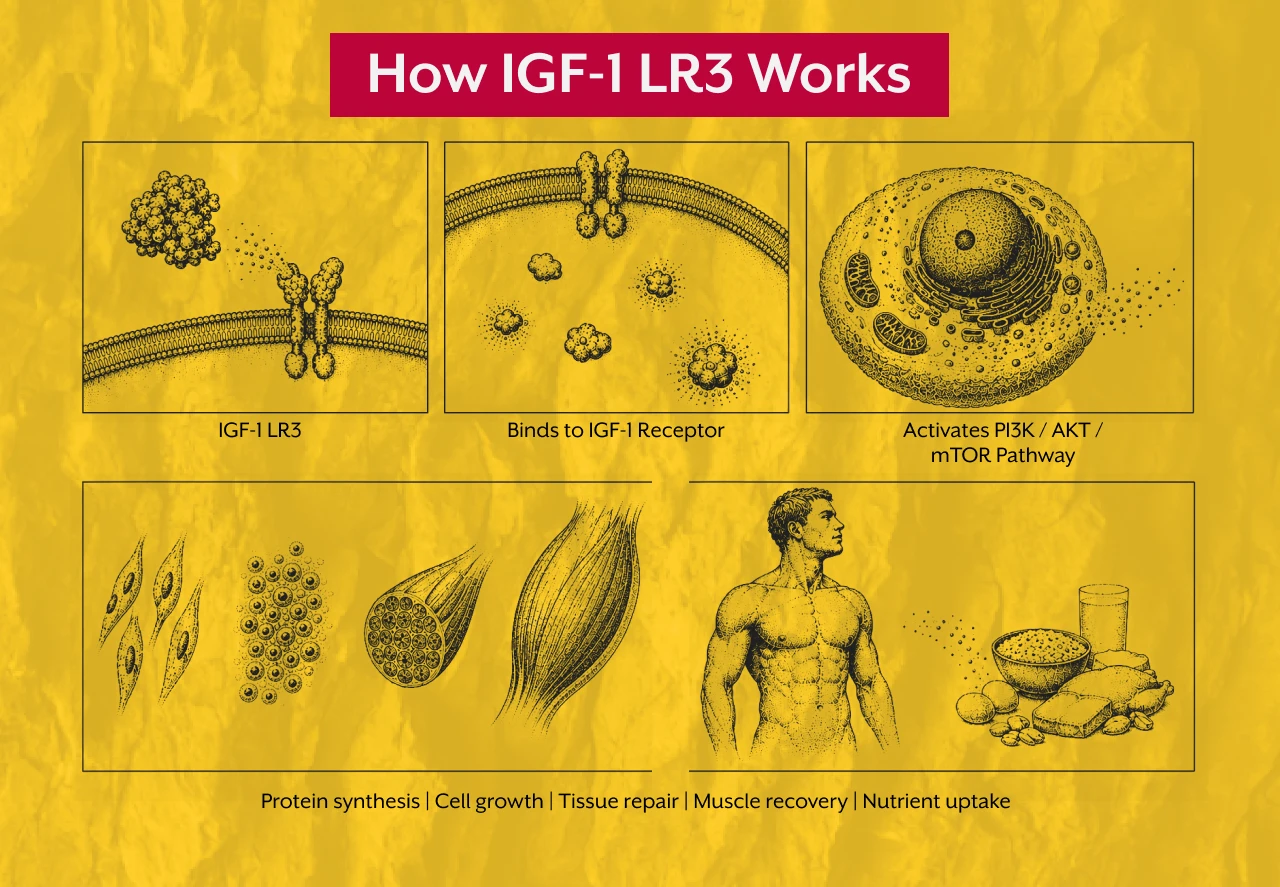
IGF-1 LR3 works like natural IGF-1 binding to the IGF-1 receptor. The IGF-1 receptor is present on most cells in the human body, particularly in muscle, cartilage, and connective tissues. The easiest way to understand how this works is to envision the IGF-1 receptor as a lock and IGF-1 LR3 as the key. Fortunately, IGF-1 LR3 fits that lock almost as well as the body’s natural key. Upon activation of the IGF-1 receptor, a signaling cascade is initiated within the cell.
This signaling cascade occurs primarily through the PI3K/AKT/mTOR pathway. If you have read any article on muscle growth, you have likely heard of mTOR. mTOR is responsible for protein synthesis. When mTOR is activated, it instructs our cells to produce more protein, absorb more nutrients like amino acids and glucose from the blood, and enter a growth-oriented state.
Since IGF-1 LR3 has a low affinity for binding proteins, a greater amount of it stays “free” and active for longer. Essentially, it can exert its effect longer after a single dose when compared to natural IGF-1.
Potential Effects of IGF-1 LR3
Based on current studies and reported use, the areas most often linked to IGF-1 LR3 applications are:
- Muscle growth
- Activation of the PI3K/AKT/mTOR pathway theoretically allows IGF-1 LR3 to aid in increased muscle protein synthesis and hypertrophy, particularly in combination with resistance training.
- Recovery from training or injury
- Its involvement with satellite cell activation also creates interest in its ability to help recover from strenuous workouts or soft tissue injuries.
- Fat loss
- While some evidence points to IGF-1’s involvement in nutrient partitioning within the body, promoting lean tissue growth over fat storage, this is far less researched than its anabolic effects on muscle tissue.
- Localized vs. Systemic effects
- Due to its prolonged activity in the bloodstream, IGF-1 LR3 is frequently discussed with respect to both localized impact (when injected near a muscle group) as well as systemic effects on the body as a whole.
It is important to note that the majority of evidence for IGF-1 LR3 specifically comes from in vitro (cell) studies and older laboratory research rather than robust, controlled human clinical trials. Much of what is understood about its mechanism is extrapolated from research on natural IGF-1 and growth hormone physiology, rather than dedicated trials on the LR3 analog itself.
How is IGF-1 LR3 Administered?
IGF-1 LR3 has been most commonly referenced as being administered via subcutaneous injection. It is typically provided as a lyophilized powder that must be reconstituted with bacteriostatic water before administration. Due to its extended half-life compared to native IGF-1, it is generally used less frequently than shorter-acting peptides, although protocols used in scientific and anecdotal discussions vary widely.
Safety Considerations and Side Effects
A lot of attention needs to be given to IGF-1 LR3 as it is a powerful molecule and has more warnings associated with it than most other peptides:
- Hypoglycemia risk
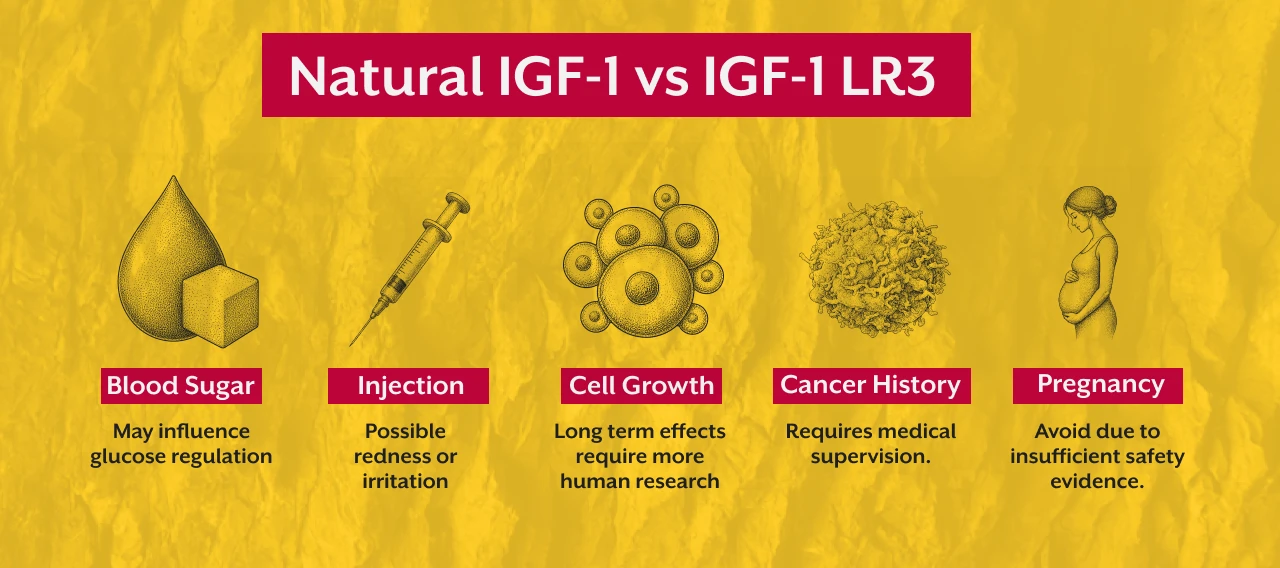
- Because IGF-1 is similar in structure to insulin and can bind to the insulin receptor when present in high concentrations, use of IGF-1 LR3 has been implicated in users experiencing low blood sugar. The likelihood of this occurring may be dose-dependent.
- Injection-site reactions
- Like most peptides that are administered via injection, some users have reported mild redness, swelling, or irritation at the injection site.
- Organ and tissue growth concerns
- Because IGF-1 signaling affects cellular growth and proliferation throughout the body and not exclusively in skeletal muscle, there is concern that long-term use of IGF-1 could result in increased growth of other tissues/organs in the body. To our knowledge, there is a lack of long-term human research that explores the safety of IGF-1 LR3 specifically regarding this point.
- Pre-existing health conditions
- As always, people with pre-existing health conditions should take extra caution before using IGF-1 LR3. More specifically, if you or someone in your family has a history of cancer or growth abnormalities, you may want to avoid IGF-1 altogether given its primary function as a growth hormone.
- Pregnancy and breastfeeding
- No research has been conducted to show that IGF-1 LR3 is safe for use during pregnancy or breastfeeding. It should be avoided in these circumstances.
Like we said, peptides are just one piece of a larger puzzle in regards to muscle growth, recovery, and overall metabolic health. Before even thinking about adding a peptide into the mix, consider getting some baseline numbers pulled. Book your Root Cause Analysis with iThrive, and we can get you on the path to building a plan specific to your body’s needs.
Key Takeaway
IGF-1 LR3 is a modified version of a peptide our body produces naturally. It was designed to have a much longer half-life in circulation compared to natural IGF-1. It can activate many of the same growth and repair pathways that are recruited during muscle protein synthesis and recovery. For this reason, it has gained considerable popularity in strength and aesthetics circles. However, much of the evidence supporting IGF-1 LR3 is from in vitro and animal studies. Clinical trials on humans are limited. Its potency brings certain risks, particularly around blood sugar regulation and uncontrolled tissue growth. As with any peptide, understanding the mechanism is only the first step; understanding your own body’s baseline health is what makes any intervention meaningful and safer to consider.
References
- Bailes, J., & Soloviev, M. (2021). Insulin-Like Growth Factor-1 (IGF-1) and Its Monitoring in Medical Diagnostic and in Sports. Biomolecules, 11(2), 217. https://doi.org/10.3390/biom11020217
- Stremming J, White A, Donthi A, Batt DG, Hetrick B, Chang EI, Wesolowski SR, Seefeldt MB, McCurdy CE, Rozance PJ and Brown LD (2022) Sheep recombinant IGF-1 promotes organ-specific growth in fetal sheep. Front. Physiol. 13:954948. doi: 10.3389/fphys.2022.954948
- Assefa, B., Mahmoud, A. M., Pfeiffer, A. F. H., Birkenfeld, A. L., Spranger, J., & Arafat, A. M. (2017). Insulin-Like Growth Factor (IGF) Binding Protein-2, Independently of IGF-1, Induces GLUT-4 Translocation and Glucose Uptake in 3T3-L1 Adipocytes. Oxidative medicine and cellular longevity, 2017, 3035184. https://doi.org/10.1155/2017/3035184



















.svg)