

.svg)
.svg)







Introduction
Peptides are one of the hottest topics trending in regenerative medicine and longevity right now. More and more people are talking about glow peptides, specifically how this peptide blend may promote healthier-looking skin, tissue regeneration, and skin repair/rejuvenation. Influencers are pushing glow peptides on social media every day, peptide shops are advertising them on billboards at every intersection, and the biggest peptide junkies are swearing by them. Everyone is talking about how glow peptides may help you achieve the brightest, firmest, and youngest-looking skin.
But what are glow peptides, how do they work, and what does science actually say about them? Before trying any peptide protocol, it’s important to understand what you’re putting in your body. So what are the ingredients in glow peptides? What are the pros and cons? Are there any glow peptide side effects? And most importantly, how can you use glow peptides safely?
We cover the science behind glow peptide blends, analyze the research that is currently out there, discuss glow peptide side effects, and tackle the question of how to use glow peptides from a learning standpoint.
What Is a Glow Peptide?
Unlike single amino acid chain peptides, the glow peptide itself is typically not just one amino acid sequence but rather a proprietary blend of multiple peptides with regenerative properties. There is no one size fits all formula and each brand may have different ingredients.
The most common glow peptide blend:
- GHK-Cu (Copper Tripeptide-1)
- BPC-157
- TB-500 (a synthetic fragment of Thymosin Beta-4)
One theory is that each ingredient supports various mechanisms of tissue regeneration and repair. Combined, the ingredients are purported to promote skin quality, collagen production, wound healing, and recovery. Though the individual ingredients have been studied, this combination has not been well researched in large clinical trials on humans.
Understanding the Science Behind Glow Peptides
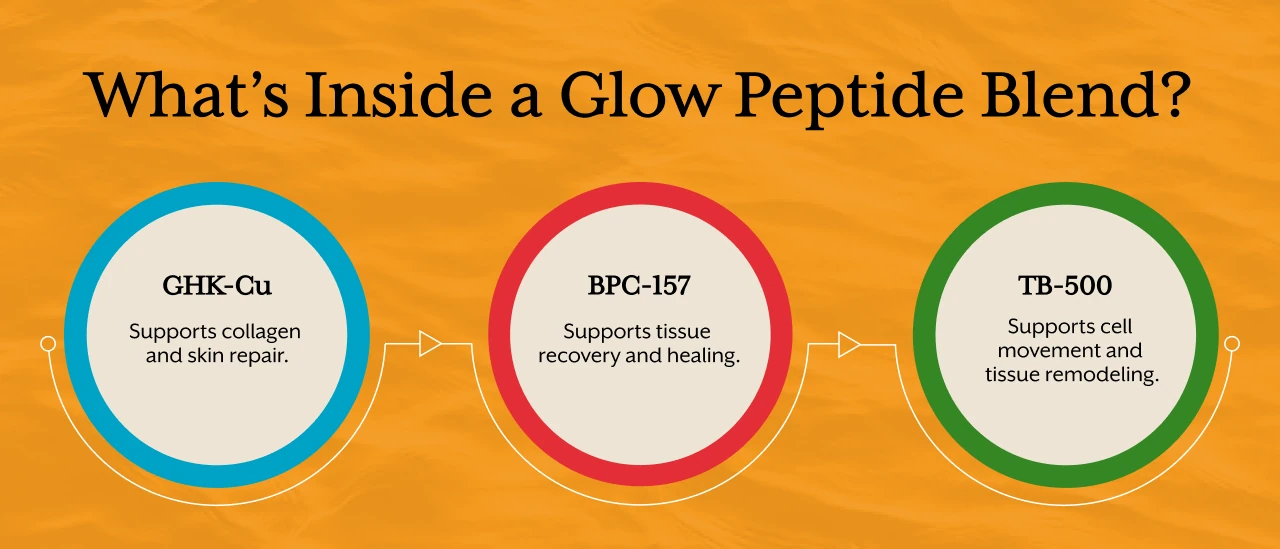
Glow peptides are built on the idea that if you pair peptides against multiple biological pathways related to repair and tissue maintenance you will achieve better results.
GHK-Cu
GHK-Cu is probably the most studied ingredient of the majority of Glow formulations. It is naturally found in human plasma, saliva, and urine as a copper-binding peptide. Levels decrease with age.
Research suggests that GHK-Cu may:
- Support collagen synthesis
- Improve skin elasticity
- Encourage elastin production
- Promote wound healing
- Reduce oxidative stress
- Modulate inflammatory responses
Laboratory and clinical studies have reported topical GHK-Cu is efficacious for improving skin appearance. This qualifies it as one of the most evidence-based cosmetic peptides available today.
Want to understand why GHK-Cu is considered one of the most researched regenerative peptides? Read our complete guide on GHK-Cu peptide benefits and how it supports skin repair and collagen production.
BPC-157
BPC-157 is a synthetic peptide originally derived from a protective protein sequence found in gastric juice.
Most available evidence comes from laboratory and animal studies, where researchers have observed potential effects on:
- Tendon healing
- Ligament repair
- Muscle recovery
- Gastrointestinal tissue repair
- Angiogenesis
- Inflammatory signaling
Although these findings are promising, robust human clinical trials remain limited.
TB-500
TB-500 is a synthetic fragment modeled after the naturally occurring protein Thymosin Beta-4.
Research has explored its potential role in:
- Cell migration
- Tissue remodeling
- Wound healing
- Muscle recovery
- Reduced scar formation
Like BPC-157, much of the evidence comes from preclinical studies rather than large-scale human research.
Tissue repair involves multiple biological pathways. Learn how KLOW Peptide Blend combines GHK-Cu, BPC-157, TB-500, and KPV to support healing from multiple angles.
How Does the Glow Peptide Blend Work?
The idea behind the glow peptide blend is that combining peptides with complementary biological actions may support multiple aspects of tissue repair simultaneously.
Researchers believe these peptides may influence processes such as:
- Collagen remodeling
- Fibroblast activation
- Angiogenesis
- Cellular communication
- Extracellular matrix maintenance
- Oxidative stress regulation
Instead of filling things in like moisturizers and creams, peptides signal cells. Peptides are like communication signals your body sends to potentially stimulate repair-type activities from your cells.
Just so you know, although these actions make sense biologically there is still limited research on the combination Glow Peptide formula.
Potential Benefits of Glow Peptides

Clinics offering wellness injections and peptide suppliers often list an extensive list of potential benefits that glow peptides may offer cosmetically. Some results that have been reported include:
- Improved skin moisture
- Radiant skin
- Increased skin elasticity
- Decreased fine lines
- Improved skin texture
- Promotes collagen production
- Accelerated healing post cosmetic procedures
- Healthy hair
- Strong nails
In reality, the majority of these claims come from provider experience/anecdotal feedback or are being made by taking the data from studies that have been done on the individual ingredients of the peptide blend (versus a clinical study on the blend).
What Does Current Research Say?
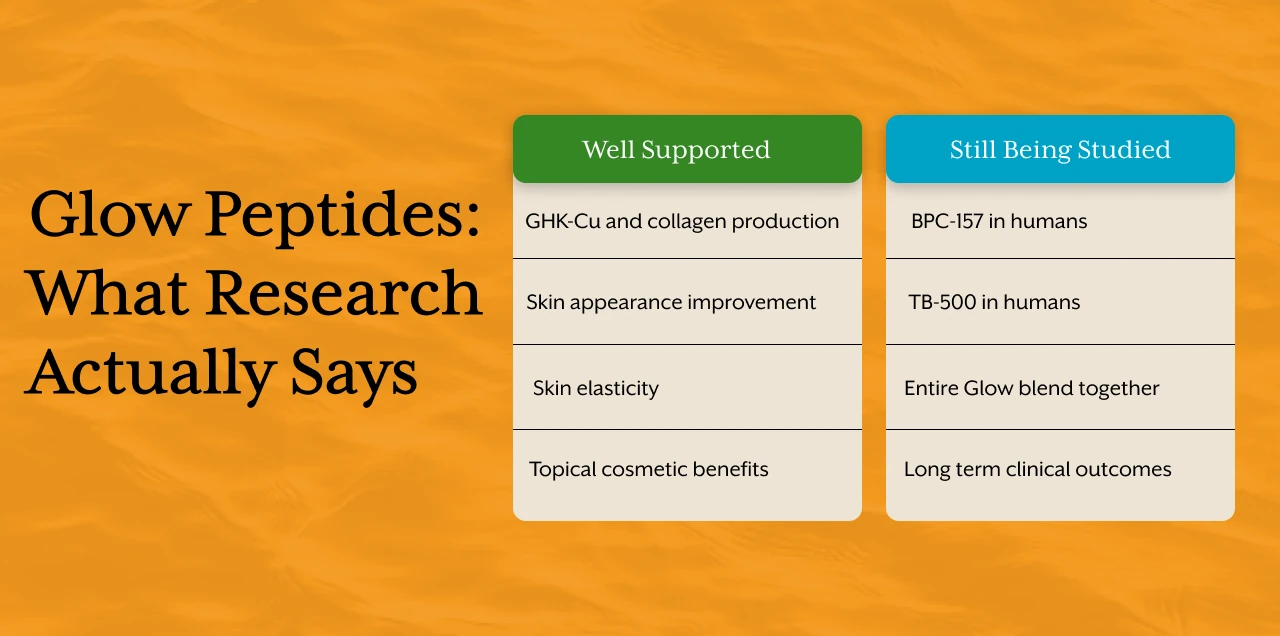
A number of ingredients in regenerative peptides are still being explored scientifically. Some ingredients have better evidence than others.
So far GHK-Cu has the best research and it seems to have promise when used topically for cosmetic purposes. There are several studies that indicate it may help promote collagen production and improve skin appearance.
BPC-157 and TB-500 on the other hand still lack randomized controlled trials in humans. Research in a laboratory and animal settings look promising, but we still require high quality studies in humans.
We also do not have any large clinical studies that show if the full glow peptide formula works or not.
Glow Peptide Side Effects
One of the most common questions people ask concerns glow peptide side effects.
Since Glow Peptide formulations vary, side effects may differ depending on the ingredients, dosage, product quality, and route of administration.
Reported side effects may include:
- Injection-site redness
- Mild swelling
- Temporary discomfort
- Bruising
- Headache
- Fatigue
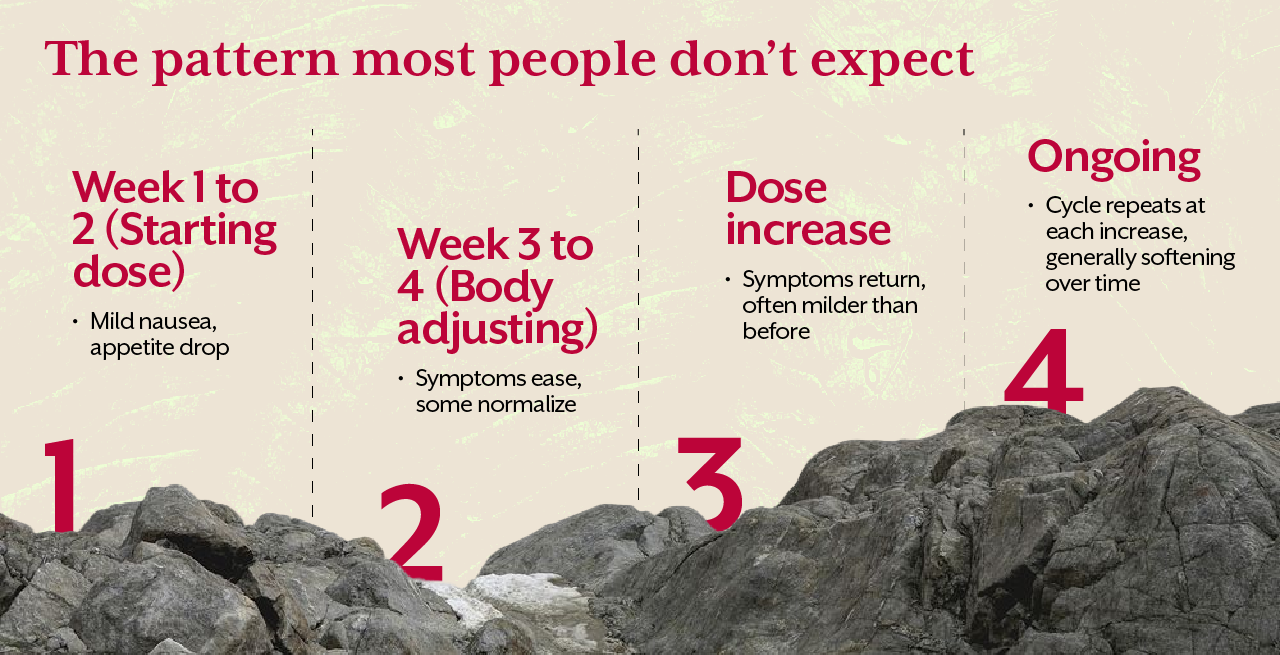
- Nausea
- Skin irritation
- Allergic reactions
In addition to ingredient-related effects, there are also important considerations regarding manufacturing quality. Some peptide products are sold for research purposes or compounded under varying standards, which may affect purity, consistency, and sterility.
Because long-term human safety data are limited, the complete safety profile of many Glow Peptide formulations has not yet been established.
Glow Peptide How to Use
People frequently search for how to use glow peptide, but there is no universally accepted dosing protocol or standardized treatment regimen.
The appropriate approach depends on several factors, including:
- The specific formulation
- Concentration of each peptide
- Intended purpose
- Individual medical history
- Clinical supervision
Anyone considering peptide therapy should consult a qualified healthcare/nutrition professional who is knowledgeable about peptide-based treatments, particularly if they have underlying medical conditions, are pregnant or breastfeeding, or take prescription medications.
Who May Be Interested in Glow Peptides?
Interest in glow peptides is particularly common among individuals seeking non-surgical approaches to skin health and regenerative medicine.
These may include people looking to support:
- Healthy aging
- Skin quality
- Recovery following cosmetic procedures
- Tissue repair after injury
- General wellness
However, expectations should remain realistic. Current scientific evidence does not support viewing Glow Peptide as a proven anti-aging treatment or replacement for established medical or dermatological care.
Lifestyle Factors Still Matter
Even the most promising regenerative therapies cannot replace the fundamentals of healthy skin.
Research consistently shows that skin health is influenced by:
- Adequate sleep
- Balanced nutrition
- Regular physical activity
- Sun protection
- Smoking avoidance
- Proper hydration
- Stress management
Peptides, where appropriate, should be viewed as one possible component of a broader approach rather than a standalone solution.
Before considering any peptide protocol, it’s important to understand what’s actually driving your skin concerns, inflammation, or recovery challenges. Book your Root Cause Analysis for a personalized functional health assessment.
Final Takeaway
The Glow peptide formulation is one of the more controversial peptide stacks in the regenerative wellness community due to the fact that it bundles together three different peptides. GHK-Cu shows some promising preliminary data when it comes to skin health while BPC-157 and TB-500 are both under investigation for their possible tissue healing capabilities.
While the buzz around glow continues to build year after year, it’s critical we separate promising early science from true clinical data. As far as the Glow peptide specifically goes, there’s a lot of support for GHK-Cu on its own but not much when it comes to the synergistic effects of the glow peptide formula. Anyone looking into “how to take” will also need to realize that there are no formal dosing guidelines. Deciding on dosage amounts and treatment lengths should be done so in consultation with a trained medical professional.
Understanding Glow peptide side effects, researching the limitations of current research data and having realistic expectations going into your wellness journey are always important. We hope to see more human clinical research in the near future to better understand Glow Peptide's role in skin health and regenerative medicine. For now, consider it a budding field of study rather than an “get younger” magic bullet.




















.svg)