




70% of women with PCOS have this one hidden problem (no, it’s not your ovaries)
Table Of Content
Treat the cause first

70% of women with PCOS have this one hidden problem (no, it’s not your ovaries)

iThrive Team
Aug 7, 2026

Irregular periods often get blamed on "PCOS" like it's the disease itself, it isn't. PCOS full form is Polycystic Ovary Syndrome, but periods are just the symptom for most women, the real driver is actually insulin.

What is the meaning of PCOS?

PCOS full form in medical terms is Polycystic Ovary Syndrome. It means a woman's metabolism and hormones have gone out of balance, raising androgen levels. This further affects periods, skin, hair, mood, weight, and fertility. 

What is the real PCOS root cause? 

For most women, the PCOS root cause is insulin resistance. When insulin stays high for too long, the ovaries get pushed to produce more testosterone. Then that excess testosterone drives irregular cycles, acne, hair loss, and weight gain. 

The 3 types of PCOS. 

  • Insulin-resistant PCOS, the most common type, which is driven by poor blood sugar control.
  • Inflammatory PCOS, low-grade inflammation disrupts ovulation.
  • Adrenal PCOS, driven by stress and overactive adrenal glands.

Signs your PCOS is insulin-driven. 

Weight that concentrates around the belly, sugar cravings right after meals, skin tags, dark patches on the neck or underarms, and fatigue that hits after eating are common signs. Of course not every woman with PCOS shows all of these, but if several feel familiar, insulin is most likely playing a central role.

What about the cysts?

The name "polycystic" is misleading. The so-called cysts are actually small, immature follicles that never fully developed because ovulation didn't happen properly. Not every woman with PCOS has these follicles, and again like not every woman with these follicles has PCOS, diagnosis can't rely on ultrasound alone.

Why is PCOS so common in India?

High rates of insulin resistance, diets high in refined carbs as well as seed oils, sedentary lifestyles, chronic stress, and widespread Vitamin D deficiency create near-perfect conditions for PCOS. India has one of the highest prevalence rates in the world, yet the awareness stays quite low.

PCOS symptoms and treatment: What doctors usually miss.

Standard PCOS symptoms and treatment usually means the pill for cycles and metformin for insulin. Both manage symptoms and neither explains why insulin went high in the very first place. Symptoms typically return the very moment the treatment stops.

Conventional Treatment vs Root Cause Approach
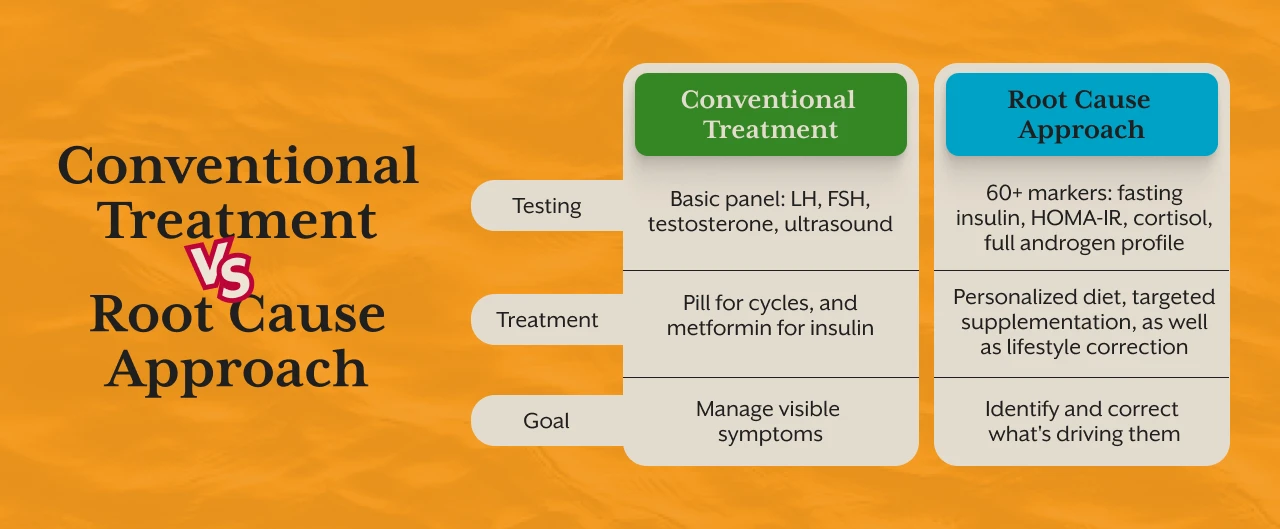
Conventional Treatment vs Root Cause Approach

Can PCOS be reversed naturally in India?

Yes, when the root cause is identified and treated. To reverse PCOS naturally in India means correcting insulin resistance, inflammation, gut health, as well as nutrient deficiencies together, not chasing one marker like testosterone alone.

PCOS diet chart: What actually matters.

A useful PCOS diet chart has never been about cutting carbs blindly. It's always about eating in a way that keeps insulin stable like protein and fiber with every meal, minimal refined sugar and seed oils, along with consistent meal timing. The exact ratios depend on your own blood work.

A sample structure is like protein and healthy fat within an hour of waking, fiber-rich meals every 3-4 hours, and carbs paired with good quality protein rather than eaten alone. This alone won't completely reverse PCOS, but it rather stabilizes the insulin spikes that keep the symptoms active.

Best PCOS supplement support. 

No single PCOS supplement fixes everything, because PCOS has multiple root causes working together. Myo-inositol is one of the most researched nutrients for improving insulin sensitivity and restoring ovulation.

Active B-Complex combines Myo-Inositol with active folate (Quatrefolic®) and methylated B12 to support insulin signalling, ovarian function, and methylation pathways together instead of one nutrient at a time.
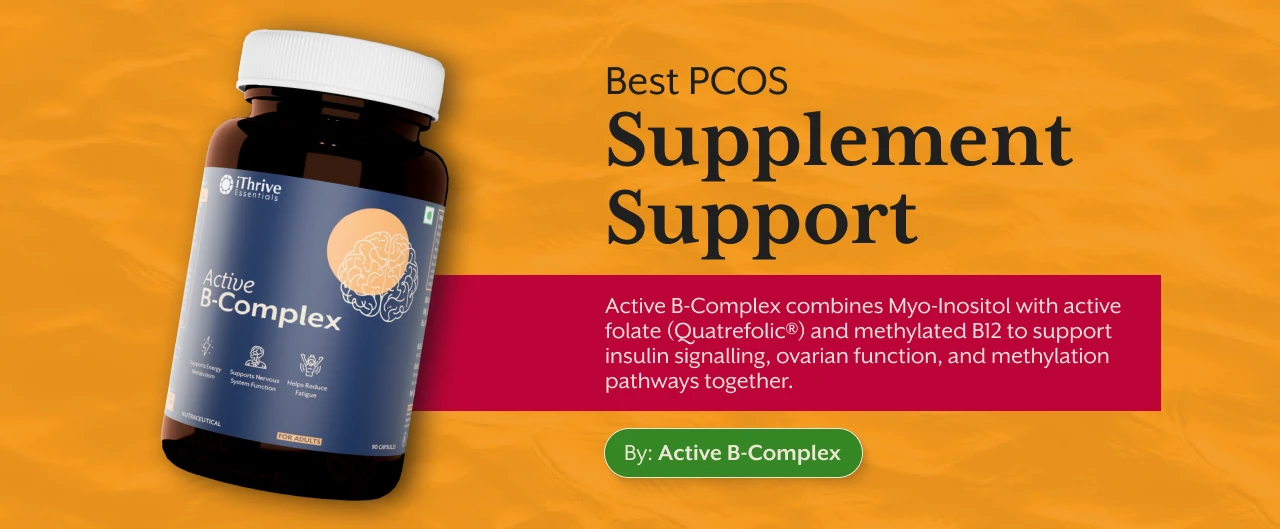
Buy Active B-Complex

Can PCOS affect fertility?

PCOS is one of the most common causes of ovulatory infertility, but it's often reversible. When hormonal and metabolic imbalances are corrected, insulin sensitivity improves, androgen levels drop, and ovulation can resume naturally, further improving the chances of conception without always needing assisted methods.

This is why treating PCOS as purely a "fertility issue" and jumping straight to fertility drugs can miss the point. If insulin resistance is still driving the hormonal imbalance underneath, ovulation support alone often works only temporarily.

Is PCOS connected to mood and mental health? 

Yes, directly. Hormonal imbalances, insulin resistance, and chronic inflammation all affect brain chemistry as well as mood regulation. Many women with PCOS describe anxiety, low mood, and brain fog that no one connects back to their diagnosis.

This isn't "just stress." When the underlying insulin and inflammation issues are addressed, many women notice real, and significant improvements in anxiety, sleep, and mental clarity.

What happens if PCOS is left unaddressed? 

Left unmanaged beyond the pill and metformin, PCOS doesn't plateau. Cycles stay irregular, fertility gets affected, and the risk of Type 2 Diabetes, cardiovascular disease, and fatty liver rises over time. The earlier the root cause is addressed, the wider the window for reversal.

How to actually find your PCOS root cause.

Guessing at supplements or following a generic PCOS diet chart rarely works, because everyone's underlying drivers differ. iThrive's PCOS Root Cause Analysis tests 60+ markers including fasting insulin, HOMA-IR, cortisol, thyroid, and full androgen profile to show exactly what's driving your PCOS.

The process is very simple: book your Root Cause Analysis, get your blood work done at home, and sit down with a functional nutritionist who explains what your markers actually mean.

Key Takeaway

PCOS full form is Polycystic Ovary Syndrome, but it's a metabolic and hormonal condition, not just a reproductive one. The PCOS root cause is usually insulin resistance, which drives up androgen levels and causes most visible symptoms. The pill and Metformin just manage the symptoms, they never fix the insulin resistance or inflammation underneath. A proper PCOS diet chart and PCOS supplement plan should always be built around your own blood work. PCOS can affect fertility and mental health too, both often improve once the root cause is treated. Reverse PCOS naturally in India by identifying and correcting the actual drivers, not just suppressing the symptoms.

A
Ask your doubts
Thank you! Your submission has been received!
Oops! Something went wrong while submitting the form.

FAQs

What is PCOS full form in medical terms?
faq arrow

PCOS stands for Polycystic Ovary Syndrome, a hormonal and metabolic condition, not just a reproductive one.

What is the meaning of PCOS beyond periods?
faq arrow

It means androgen levels have risen due to an underlying imbalance, usually insulin resistance, affecting skin, hair, weight, mood, and fertility along with cycles.

Can PCOS actually be reversed naturally?
faq arrow

For many women, yes. When root causes like insulin resistance and inflammation are corrected, cycles regularize and symptoms reduce significantly.

Is the pill treating my PCOS root cause?
faq arrow

No. It suppresses your natural cycle and creates the appearance of regularity, without addressing insulin resistance, inflammation, or nutrient deficiencies underneath.

Does weight loss fix PCOS, or does PCOS make weight loss harder?
faq arrow

Both are connected through insulin. Weight gain in PCOS is driven by insulin resistance, which makes fat loss harder regardless of effort. Fixing insulin function first makes weight loss a natural result, not a constant struggle.

Related Blogs

Optimal range vs Reference range: Why "normal" blood reports miss early disease.
read count
read time
Aug 4, 2026

Optimal range vs Reference range: Why "normal" blood reports miss early disease.

Your blood report may say “normal,” but that doesn’t always mean you’re healthy. Learn the difference between optimal range and reference range, why common markers like TSH and LDL can be misleading, and how early dysfunction is often missed.

Your blood report says "normal." But if you still feel tired, foggy, or off, the gap between how you feel and what your report says usually comes down to one thing which is optimal range vs reference range blood test results and most doctors never explain the difference.

What is a reference range?   

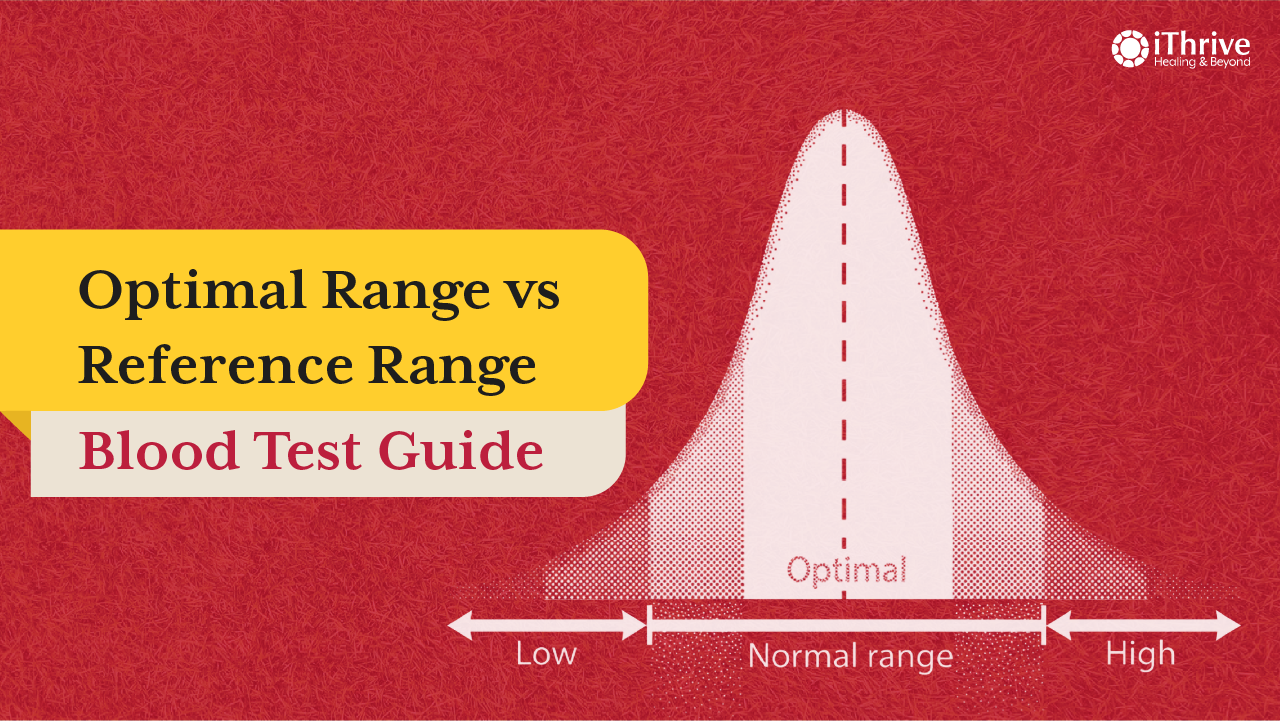
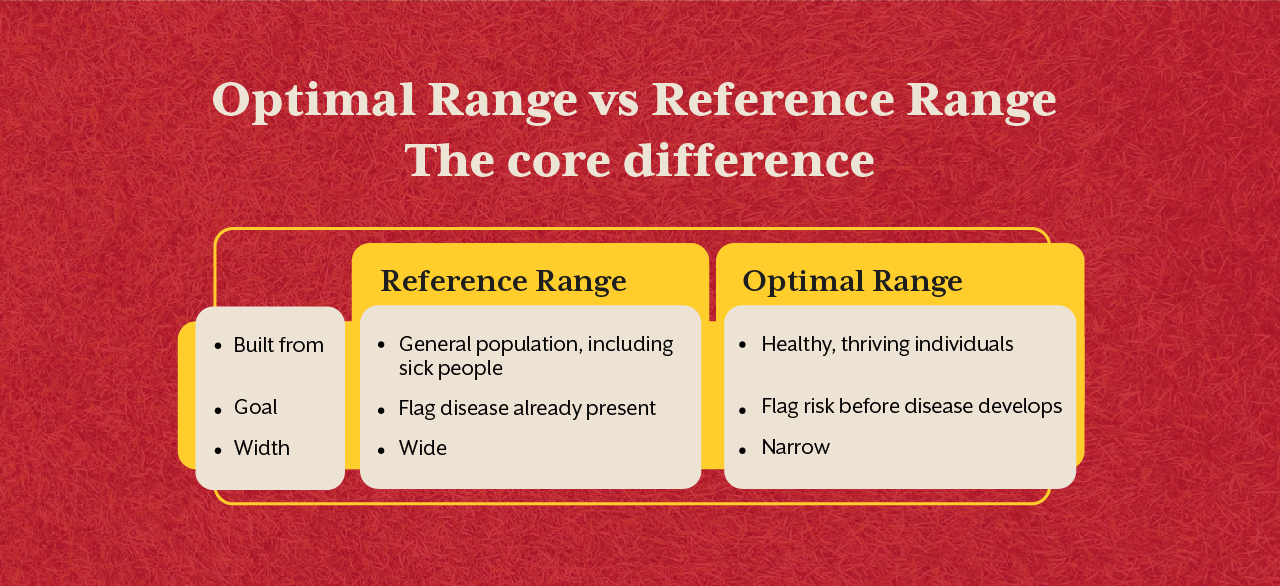
A reference range is the standard "normal" window that is printed next to your result. Labs build it by testing thousands of people, including undiagnosed or mildly sick ones then take the statistical middle 95%. It tells you if you're average but it never conveys that you're healthy.

What is an optimal range? 

Optimal meaning, in this context is the narrower band linked to the lowest disease risk and best long-term function in research. It's built from thriving, healthy individuals, and not the general population. Sitting inside your reference range doesn't mean you're inside this optimal window.

Optimal Range vs Reference Range: The core difference 

A reference range always asks are you average? An optimal range asks, are you thriving? Like a marker can sit safely inside the reference range for years while quietly drifting towards a dysfunction, simply because the reference range is too wide to even notice. 

Optimal Range vs Reference Range

Reference Range vs Optimal Range: Comparison Chart

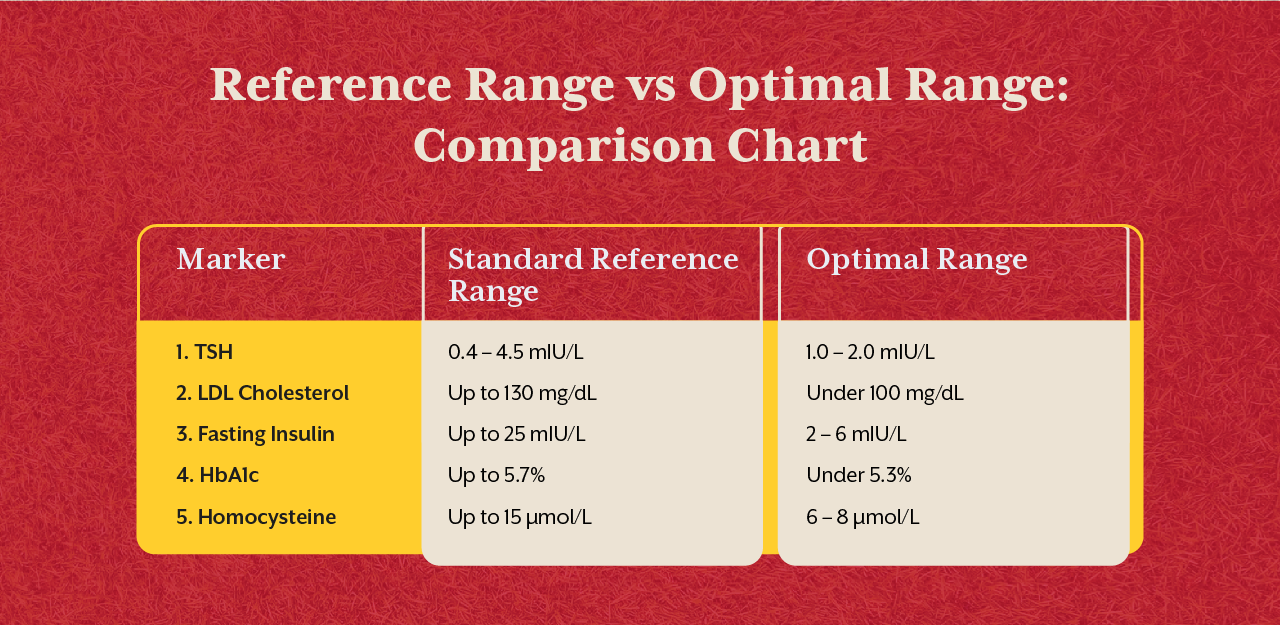
Here's what the gap actually looks like on common markers. This is why two people can both be told "normal" while only one of them is actually well.

Reference Range vs Optimal Range: Comparison Chart

Values are approximate and vary slightly by lab. The pattern stays the same across almost every marker: the reference range is wide enough to hide dysfunction the optimal range is designed to catch.

Are reference range and normal range the same? 

Yes. "Normal range" and "reference range" mean the same thing, both of them describe the wide, population-based window printed on your lab report. Neither term implies optimal health, they only show where you stand compared to everyone tested, sick or well.

What does a reference range not detect? 

A reference range doesn't detect slow, early dysfunction. It ignores your age, symptoms, and personal history, and it can't distinguish early-stage disease from a lucky test day. Two very different people can both read "normal" on paper.

TSH Normal Range vs Optimal Range

The standard TSH normal range on most lab reports runs roughly 0.4 to 4.5 mIU/L. Optimal ranges used by thyroid specialists sit closer to 1 to 2 mIU/L. Someone at 4.2 is normal on paper but is often already fatigued, foggy, and gaining weight all the way.

Ldl cholesterol

LDL cholesterol normal range vs optimal range

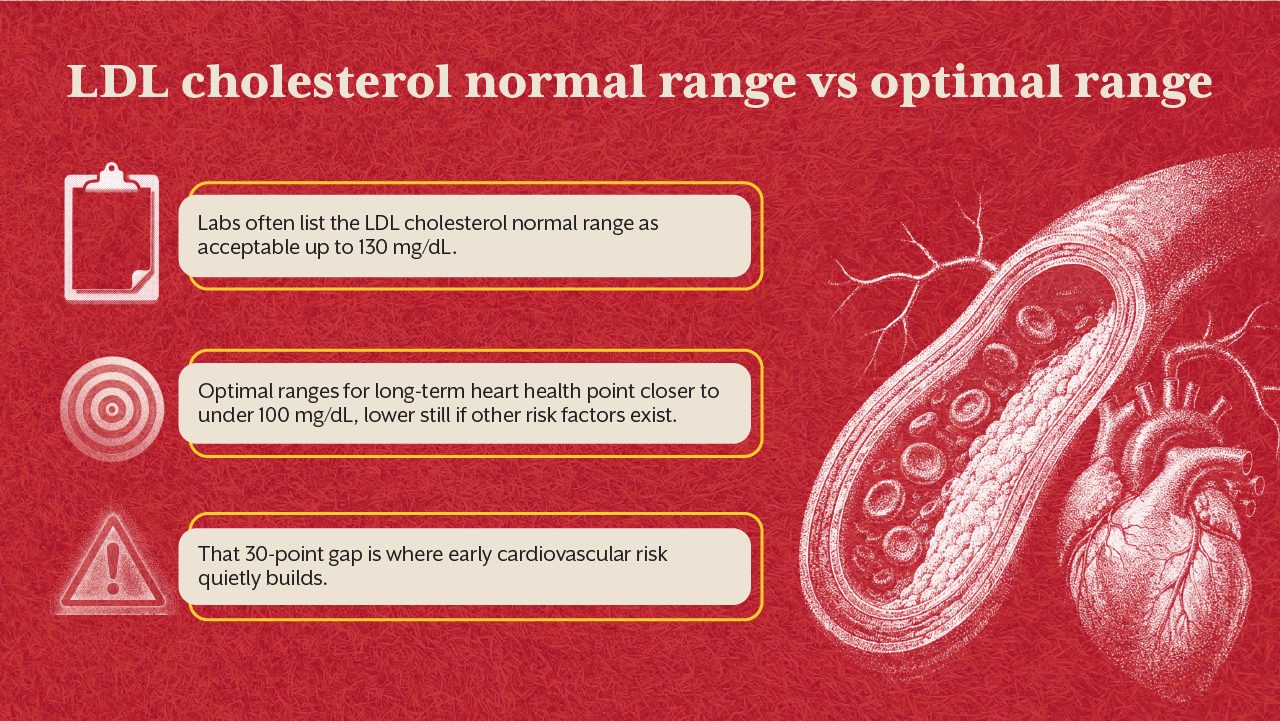
Labs often list the LDL cholesterol normal range as acceptable up to 130 mg/dL. Optimal ranges for long-term heart health point closer to under 100 mg/dL, lower still if other risk factors exist. That 30-point gap is where early cardiovascular risk quietly builds.

Why do "normal" reports miss early disease? 

Dysfunction builds slowly, like one small shift at a time. Reference ranges are wide enough to hide that entire process. By the time a marker actually crosses into "abnormal," the underlying issue has usually been developing for years already.

How to actually read your blood work? 

Reading one marker at a time against a wide range is why reports keep saying "fine" while you don't feel fine. What matters is reading 60+ markers together, against optimal ranges, alongside your symptoms and history. 

This is exactly what iThrive's Root Cause Analysis does. It uses the ranges your doctor doesn't, so it catches what standard testing is built to miss, and connects the dots between markers instead of scoring each one alone.

Normal vs Optimal lab results: What it means for you.

A normal lab result only confirms you're inside the wide reference window, it says nothing about whether your levels support real vitality. An optimal result means your markers sit in the range tied to peak function and the lowest disease risk. Chasing normal keeps you stable but chasing optimal keeps you well.

The Real Cost of Ignoring the Gap

Most chronic disease doesn't appear overnight, it always accumulates for years while every report says normal. Someone with a TSH of 4.0, LDL of 125, and fasting insulin of 20 can walk out of 3 straight check-ups with a clean report. None of those numbers cross a line on their own.

But together, they paint a different picture, like one drifting toward hypothyroidism, insulin resistance, or heart disease, quietly, one report at a time. This is the real cost of relying only on reference ranges. 

The years when a small shift in diet, sleep, or supplementation could have reversed the trend get spent believing nothing is wrong. By the time a marker finally tips into "abnormal," the fix usually takes longer and costs more than it would have earlier.

Optimal ranges close this gap. They flag the drift while it's still reversible, not after it becomes a diagnosis. That's the real value of testing against a narrower, evidence-based window instead of a wide population average.

This is exactly where a structured Root Cause Analysis matters most. Instead of waiting for one marker to cross a line, it tracks how your markers move together over time, against optimal ranges so the drift gets caught while it's still a pattern, and not a disease.

Key Takeaways

Reference range and normal range are the same thing, a wide, population-based window, not a marker of true health. Optimal range is narrower and tied to the lowest disease risk, not just statistical averages. Common markers like TSH, LDL, and homocysteine often read "normal" while sitting well outside the optimal window. Reference ranges can't detect slow dysfunction, symptoms, or personal trends. A Root Cause Analysis reads markers together against optimal ranges, catching drift a standard report misses entirely.

Exploring the types and Root Causes of Acne
read count
read time
May 10, 2024

Exploring the types and Root Causes of Acne

What are the Root Causes of Acne? It can be really frustrating when you can see your skin being affected by the problem of acne but you are not able to find out the reason behind it. Acne has deeper reasons than just what you see on your skin.

Acne is a skin condition that is particularly common during adolescence. About 95% of adolescents have this problem.  Even in adulthood, up to 54% of people have acne, which can last until middle age. But what exactly is acne, and why does it occur? Let’s examine the different types of acne and find out the causes of this troublesome skin condition.

What is Acne?

It is a common skin condition caused by clogged hair follicles under the skin that are filled with dead skin cells and sebum, an oil that keeps the skin hydrated. On your skin, acne breakouts can occur anywhere. The face and neck, shoulders, back, and chest are among the most frequently affected areas. This is because these are the body parts where the oil glands are the most prevalent.

Let us move further to explore various types of acne.

Types of Acne

You must know that acne is not just one thing. There are different types, each with its own characteristics and causes. It's vital to identify which type you have so you can treat it properly.

  1. Acne Vulgaris: This is the most common type of acne. It includes things like blackheads, whiteheads, and pimples. So, if you're breaking out, chances are it's acne vulgaris. Here are two common types of Acne Vulgaris: 
  • Whiteheads: These are small, closed bumps that appear on the surface of your skin. They occur when a hair follicle becomes clogged with oil and dead skin cells and starts trapping bacteria beneath the skin.
  • Blackheads: Unlike whiteheads, blackheads are open bumps on the skin. They develop when the trapped oil and dead skin cells oxidize, giving them their characteristic dark colour.

  1. Comedonal acne: This type includes blackheads, bumpy skin, and small white bumps called milia. They are inflammatory skin lesions that are caused by an overabundance of sebum production, bacterial overgrowth, and hyperkeratinization.
  2. Cystic acne: Cysts are the most severe form of acne and appear as large, pus-filled lumps beneath the skin. They can be painful and may cause scarring if not treated promptly. Here are two types of cystic acne:
  • Papules: Papules are small, red bumps that may feel tender to the touch. They occur when the walls around the pores break down due to inflammation.
  • Pustules: Pustules are similar to papules but contain pus at their tips. They appear as white or yellow bumps on the skin's surface.
  1. Nodular acne: Another severe type with large, hard, deep pimples called nodules.  They are larger, solid, and painful lumps beneath the skin's surface. They develop when clogged pores become further irritated, leading to deep inflammation.
  2. Acne Rosacea: This type affects adults, typically after 30. It shows up on the face and can cause redness, pimples, and visible blood vessels. It's more common in women, but men can also be affected by it.
  3. Acne Mechanica: This type is caused by heat, pressure, or friction on the skin. It often happens on the body, especially in athletes who wear gear that traps heat and rubs against the skin. It can also occur on the face.
  4. Excoriated Acne: This happens when someone picks at their pimples excessively, causing wounds on their skin. 

It's important to understand the reasons behind your acne so that you can treat it correctly. So, let us explore the root causes of acne.

What are the Root Causes of Acne?

It can be really frustrating when you can see your skin being affected by the problem of acne but you are not able to find out the reason behind it. 

Acne has deeper reasons than just what you see on your skin. Here are some possible root causes that lead to acne:

  • Distressed Skin: Your skin has its own tiny world of bacteria, viruses, and other microorganisms. When this community gets messed up by things like strong cleansers or antibiotics, bad bugs can take over and cause acne.

  • Hormonal Imbalances: Sometimes, glands in your skin produce too much oil because of hormones. This can happen due to conditions like PCOS, pregnancy, or just changes in your body.

  • Food Troubles: Certain foods might not sit well with your gut, leading to problems with digestion and your skin. If you're allergic or sensitive to certain foods, it could show up as acne.

  • Growth Hormones: During puberty, a hormone called IGF-1 spikes up. This hormone can make your skin produce more oil, especially if you eat lots of sugary or dairy foods.

  • Fatty Acid Balance: Your diet might have too much of one kind of fat compared to another. This could make your body inflamed and might be linked to acne. Omega-3 fats are good for your skin and might help with acne.

  • Too Much B12: Taking too much vitamin B12 can actually make acne worse for some people. It changes the balance of bacteria on your face, leading to more acne.

Keeping your skin happy involves more than just washing your face. It's also about what you eat, how your body works, and what you put on your skin.

Summary

Acne is a common skin condition that includes the formation of pimples, blackheads, whiteheads, as well as other lesions. It occurs when hair follicles become clogged with oil and dead skin cells, leading to inflammation and the growth of acne-causing bacteria. Factors such as excess oil production, hormonal changes, genetics, and diet can contribute to the development of acne. Understanding the types and root causes of acne is crucial for effectively managing and treating this condition. If you are also struggling with acne, you can focus on getting functional nutrition to achieve clearer and healthier skin.

RESOURCES

  1. Understanding Acne and How to Treat it Naturally - Rupa Health

https://www.rupahealth.com/post/understanding-acne-and-how-to-treat-it-naturally

  1. Everything You Want to Know About Acne - Healthline

https://www.healthline.com/health/skin/acne

  1. Three Stages of Acne and Treatment - Verywell Health

https://www.verywellhealth.com/types-of-acne-15762

  1. Acne Vulgaris - Examine

https://examine.com/conditions/acne/

  1. Acne 101: Types, Causes, Treatments, Tips and More - Derm Collective

https://dermcollective.com/acne/

What is Root Cause Analysis (RCA) in Healthcare?
read count
read time
Apr 5, 2022

What is Root Cause Analysis (RCA) in Healthcare?

The reason behind a person's health problem is hidden in their blood. Root Cause Analysis is the best way to unearth the reason behind the symptoms or disease.

What is Root Cause Analysis (RCA) in Healthcare?

Almost everything in this world happens for a reason. If you are late for work, it might have been that you were late in waking up or got stuck in traffic or some other internal or external forces ended up making you late. The same is with your body. Nothing happens to your body without reason, Not even a disease.

A disease or disorder is the final stage of a body issue. But, it does not originate as a disease from the get-go. The first or initial stage of a disease is an anomaly in your body. It might not be anything severe. It can be as mild or as insignificant as an insufficient amount of oxygen intake. But, this insignificant anomaly, if left untreated or unsupervised, over time, can turn into a cardiovascular disease

This anomaly is what a Root Cause is. It is the hidden reason behind your health problems.

To understand this better, we can take the example of a torn shirt. You can find a temporary solution of putting a safety pin or sewing it, but none of these will help until you fix the root cause of the issue. That is by asking the question, why exactly did the shirt tear? Is it because the material was not good or had stuck on a nail somewhere, or because you have gained weight? Finding the Why and then working on fixing it will help you more than finding temporary solutions. But how do we detect this? 

How to Get Root Cause Analysis (RCA)?

Well, your doctor always asks you to get a blood report done when you go to them with a problem. The reason being, your blood is the information center of your body. Getting your blood analysed can help you detect the root cause behind your health problems. 

Multiple root causes affect a person in different ways. The reason being your body is an interdependent system. It is a beautifully complex being. Each cell has its own unique functions, which in turn help different body systems do their assigned roles. And all these systems work together in keeping the body healthy and functioning at its best.

To understand this, let's talk about hair fall. Loads of people suffer from hair fall and after countless treatments still find themselves unable to get rid of the problem. The reason being they never tried finding out the reason why. One of the reasons for this can be underlying thyroid problems, to be more precise hypothyroidism. And the reason behind the origination of hypothyroidism could be an inadequate supply of necessary nutrients to the thyroid gland to produce the thyroid hormones. Now, to identify exactly which of the necessary nutrients are you deficient of you need to get your blood analysed. 

To ensure the proper functioning of your body, you must make sure each cell in the body is working efficiently.

How Can Root Cause Analysis Help You Prevent a Disease?

As mentioned above, disease or health disorder is the final stage of a health issue. It takes time for an anomaly to manifest into a disease. This means you have plenty of time to prevent it from turning into a full-blown disease. 

As soon as an anomaly starts becoming a hindrance to your body's functioning, your body starts communicating with you. These are seen as symptoms; like headache, loss of energy, itchy skin, bloating, acidity and more. And rather than delving more into knowing why you are facing these symptoms, you suppress them on the surface by taking a tablet or using home remedies to counter them. 

But if you get a proper analysis of your bloodwork, you, with the help of a good nutritionist, can detect early on the internal issues of the body and take steps to overcome those issues. These will help maintain proper blood parameters, which informs you that there are no issues plaguing your body.

How Can Root Cause Analysis Help You Treat a Health Problem?

Knowing the Root Causes does not merely help you prevent but can also help you reverse diseases. 

Once you know the reason behind your health problem, rather than putting your time, energy and money into treating the disease symptoms on the surface, you can start targeting the root cause. Treating the root cause will automatically start helping your body fight the adverse effects of the root cause. Or in simple terms, it will help your body reverse your disease.

You might question this saying, "how is that even possible?" Well, your body has structures in place that help it fight unwanted elements. Your body is one of the most intelligent systems. The only thing it needs to work smoothly is our support. This support comes in the form of proper nutrition and lifestyle. 

Diagnosing root causes helps prevent loads of health problems and also helps in reversing chronic diseases.

Root Cause Analysis Benefits

Analysing the reason behind your symptoms can help you in many ways, namely

  1. Finding out the reason behind your disorder
  2. Reversing chronic diseases like diabetes
  3. Preventing genetic diseases
  4. Detecting the cause of your symptoms
  5. Preventing diseases related to ageing
  6. Achieving optimum health
  7. Treating lifestyle diseases like heart diseases
  8. Maintaining your body's nutritional level
  9. Achieving sustainable health
  10. Eliminating almost all health problems 

Functional Nutritional Approach to Root Cause Analysis

Finding out the root cause of your health problems is steadily gaining attention in many healthcare sectors. Functional Nutrition, a holistic approach to healing, also uses RCA to help treat people of their health dysfunctions with a huge distinction. Rather than using normal reference ranges, Functional Nutrition uses Optimal Ranges to make a diagnosis. 

Let's see what the difference between Optimal Ranges vs Normal/Reference Ranges is

Optimal Ranges Reference Ranges
Uses ranges based on tests taken using healthy individuals as the subjects. Uses ranges based on tests taken using a large population as subjects that include unhealthy subjects and make no distinction in age or lifestyle.
They are updated every few years. They have never been updated.
They use narrow ranges. They use wide ranges.
They are very precise. They are not precise.

Another distinction in Functional Nutrition's approach to RCA is that they do not check just the necessary parameters but rather dive deep into all body parameters. A comprehensive analysis of a blood report helps get a better idea about your body's health. A Functional Nutritionist does not give up until she/he finds the Root Cause. 

Why is RCA Important?

Root Cause Analysis is an essential part of treatment, or at least should be, as it helps the healthcare practitioner pinpoint the reason or reasons behind your health dysfunction. Also, it gives insight into what parameters are to be prioritised. This helps in creating better treatment plans. Also, RCA can help distinguish areas you must work on to prevent the onset of any other health dysfunction. 

RCA helps reverse and prevent diseases and to get better results out of your blood work, it is recommended to approach a Functional Nutritionist. They will make sure the diagnosis is done using Optimal Ranges. Also, they will give you a better direction on how to proceed with your treatment. 

A good experienced Functional Nutritionist will, after the RCA, help you treat your health problems through diet, supplementation, lifestyle changes and different holistic practices.

Star Your Root Cause Analysis

Includes home blood sample collection, 1-hour expert consultation, and a next-step protocol.
Pay Now ₹2500
Secure Payments Powered By
NET
Banking

What’s Included in Your Blood Analysis?

Click below to view the complete list of markers included in your analysis.
Complete Blood Count (18 Parameters)
faq arrow
Diabetes Panel (4 Parameters)
faq arrow
Iron Studies (4 Parameters)
faq arrow
Lipid Panel (6 Parameters)
faq arrow
Thyroid Profile (3 Parameters)
faq arrow
Inflammation & Mitochondrial Health (3 Parameters)
faq arrow
Liver Function Test (8 Parameters)
faq arrow
Kidney Function & Electrolytes (9 Parameters)
faq arrow
Pay Now ₹2500
Secured payment via

We’re Not In Your City Yet But We’re Not Letting You Go.

You don’t need to wait to start understanding your body.
Get Free Consultation

You Still Get:

  • Free 1:1 consultation with our clinical team
  • Symptom + history deep dive
  • Direction on what’s actually driving your condition
  • Guidance on next best steps (tests, diet, and protocol)
Oops! Something went wrong while submitting the form.

Talk to our team

Thank you! Your submission has been received!
Oops! Something went wrong while submitting the form.

Talk to our team

Thank you! Your submission has been received!
Oops! Something went wrong while submitting the form.

Download Now

Thank you! Your submission has been received!
Oops! Something went wrong while submitting the form.
Select your Location
Agra
Ahilyanagar
Ahmadnagar
Ahmedabad
Ahmednagar
Akola
Aligarh
Allahabad
Almora
Alwar
Ambala
Ambedkar Nagar
Amravati
Amritsar
Amroha
Anand
Aurangabad
Ayodhya
Azamgarh
Baghpat
Bahadurgarh
Bahraich
Banda
Barabanki
Baraut
Bardhaman
Bareilly
Begusarai
Belgaum
Bengaluru
Bharatpur
Bhatinda
Bhilai Durg
Bhilwara
Bhiwani
Bhopal
Bhubaneswar
Bijnor
Bikaner
Bilaspur
Bokaro
Budhana
Bulandshahar
Chandigarh
Chennai
Chhatrapati Sambhajinagar
Chhindwara
Chomu
Darbhanga
Dehradun
Delhi
Deoband
Deulpur
Dhampur
Dhanbad
Durgapur
Eah
Etah
Etawah
Faizabad
Faridabad
Firozabad
Gadarpur
Gandhinagar
Ganganagar
Gaya
Ghaziabad
Ghazipur
Gonda
Gorakhpur
Greater Noida
Greater Noida Pc
Guntur
Gurgaon
Guwahati
Gwalior
Hajipur
Haldwani
Hapur
Hardoi
Haridwar
Hathras
Hazaribagh
Hisar
Hoshiarpur
Howrah
Hyderabad
Indore
Jabalpur
Jaipur
Jalandhar
Jalgaon
Jalna
Jamnagar
Jamshedpur
Jaunpur
Jhansi
Jhunjhunu
Jind
Jodhpur
Sorry, currently we are not serving this city.
Please try searching for another city or put your city here.
My Location not in the list
Your Location is 'Location'
Book a Test

City

Thank you! Your submission has been received!
Oops! Something went wrong while submitting the form.