

.svg)
.svg)







Introduction
We at iThrive have observed there is entirely another level of frustration in the clients that comes with gut issues.
Our clients often mention that they eat simple, something that will be light on the gut, yet within a couple of minutes their stomach feels stretched, unrecognisable, and heavy. By afternoon, their energy crashes for no reason. Then comes the brain fog, that strange mental cloud wherein thinking feels very slow, words don’t come easily, and even the smallest of decisions feel really exhausting.
If you’ve been there, you might have tested, everything would have looked “normal”, you might have told it’s acidity or maybe stress. But one thing that’s for sure is no one would have ever explained why your body feels like it’s working against you. For many people like you, this is exactly where the entire story of small intestinal bacterial overgrowth quietly initiates. The condition is not discussed appropriately, and majority of the times it’s misunderstood and further even mismanaged.
For that we are here. This blog will not be just about the symptoms of SIBO. It will mainly be about understanding why the symptoms exist in the very first place, and why unless you address the root, they will keep backing you.
What Is Small Intestinal Bacterial Overgrowth and Why It Matters
When Bacteria Exist in the Wrong Place
Small intestinal bacterial overgrowth is not really about having “bad bacteria.” It’s rather about having bacteria in the wrong location. So basically, your large intestine is specifically designed to house trillions of microbes, but your small intestine isn’t. It’s meant to be somewhere relatively low in bacterial density so that the absorption of nutrients and digestion can happen efficiently. So, when the bacteria migrates upward into the small intestine, they start interacting with the food even before your body gets a chance to absorb it.
And this is exactly where the problem begins.
Why This Shift Changes Everything
The small intestine is where the nutrients enter your bloodstream. If bacteria interfere here, you’re not just dealing with the digestive discomfort, but you’re also dealing with systemic consequences.
This is truly why SIBO symptoms rarely stay limited to the gut. They also show up as cognitive issues, mood changes, nutrient deficiencies, and even fatigue.
SIBO Bloating Is Not Just Gas. It Is Misplaced Fermentation
What Actually Happens After You Eat
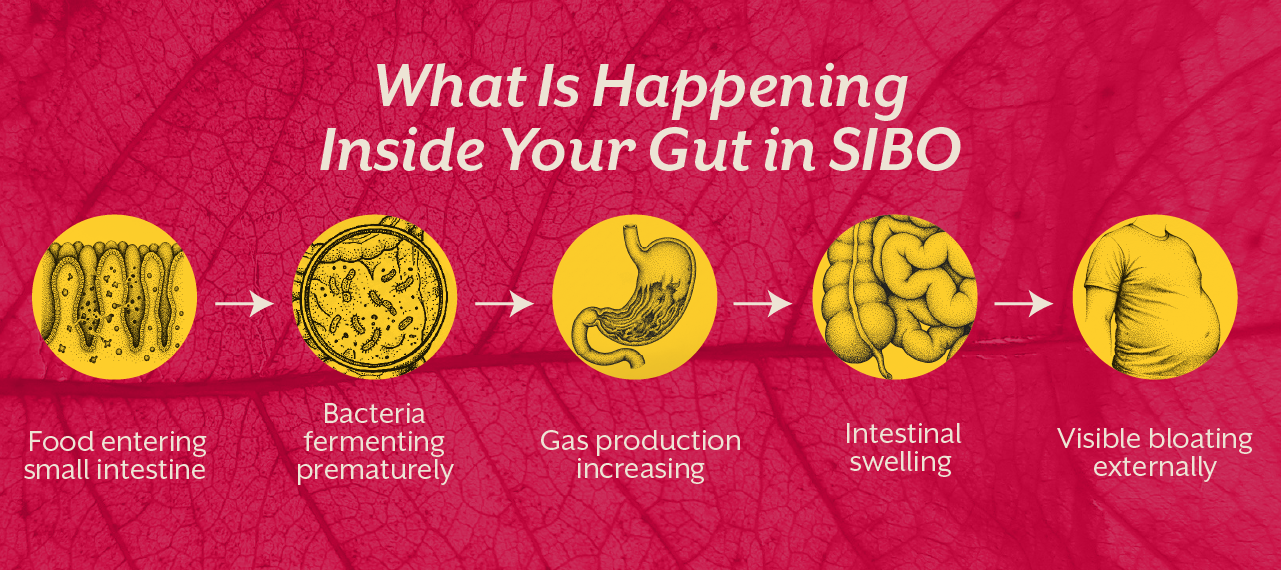
In a healthy digestive system, carbohydrates are broken down and then absorbed before they reach the colon. In SIBO, bacteria in the small intestine start fermenting these carbs too early. This premature fermentation produces gases like methane and hydrogen.
Why the Bloating Feels So Intense
The small intestine isn’t built to handle large volumes of gas. As pressure keeps building, the abdomen also starts expanding. This is why SIBO bloating often feels quite disproportionate to what you consume. It’s not really about the quantity, it’s rather about the location.
Methane dominant SIBO, is specific, slows down the movement of the gut. This then develops a cycle wherein food stays longer, fermentation maximises, and even bloating becomes persistent rather than occasional.
Why SIBO Causes Fatigue That Does Not Make Sense
The Hidden Nutrient Theft
One of the least understood SIBO causes of fatigue is nutrient competition.
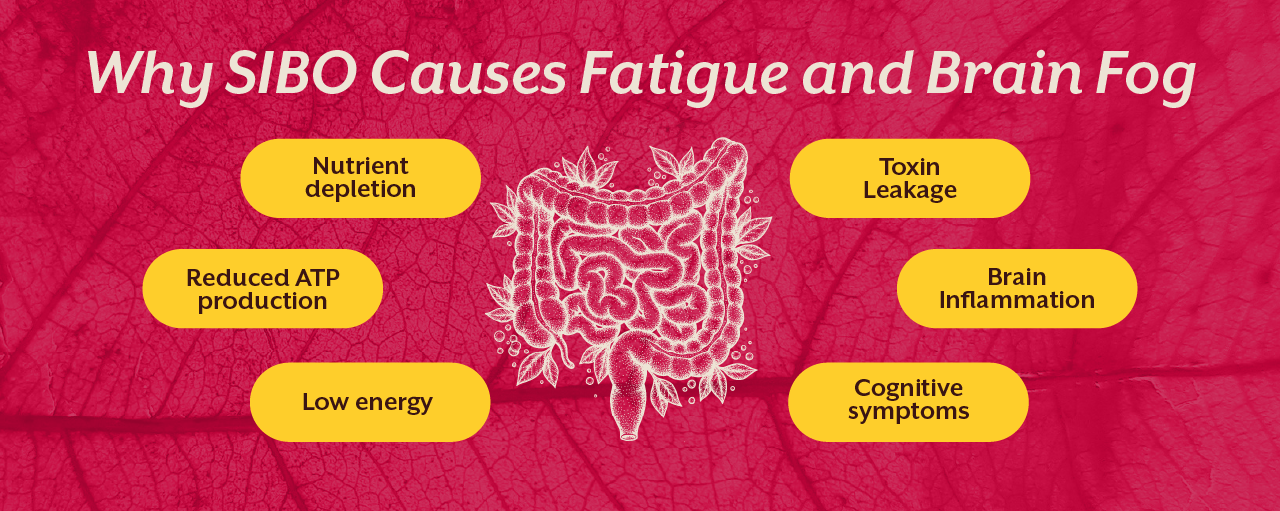
One of the most least understood and talked about SIBO causes of fatigue is nutrient competition. The bacteria in your small intestine are not passive, they in fact actively consume nutrients from your food, specifically vitamin B12, magnesium bisglycinate, and iron.
These are not optional nutrients, they are in fact central to mitochondrial energy production. So, when your cells don’t get what they need, energy drops not gradually but noticeably.
Malabsorption Changes Everything
Beyond competition, SIBO disrupts digestion of fat by potentially interfering with bile acids. This eventually affects absorption of fat soluble vitamins like A, D, E, and even K.
You might be eating well, supplementing well, and still feel really depleted, because the issue is not about intake, it’s just about absorption.
The Mitochondrial Response
When the body senses ongoing inflammation, it eventually prioritises survival over energy. This is the part of what is known as the cell danger response. Mitochondria reduces output to protect the system. This is exactly why SIBO fatigue feels so different, it’s not about your tiredness, it just feels like your system has entirely slowed down at a cellular level.
The Real Reason Behind SIBO Brain Fog
The Gut Brain Connection Is Not Abstract
SIBO brain fog isn’t psychological, it’s biochemical.
When bacterial overgrowth damages the intestinal barrier, toxins such as lipopolysaccharides enter the bloodstream. This specific state is known as metabolic endotoxemia. These toxins can eventually reach the brain and trigger inflammation.
When the Brain Feels Clouded
This inflammation affects neurotransmitter neural signalling as well as balance. Clients here at iThrive have often described themselves as feeling disconnected, very slow, or unable to focus. Tasks that once felt very simple begin to feel like taking a lot of effort.
And trust me when I say, it’s not in your head. It is coming straight from your gut.
The Role of Ammonia and Histamine
Certain bacterial strains produce ammonia, which in excess becomes neurotoxic. Others produce histamine, which can then overwhelm the ability of your body to break it down.
This is why SIBO brain fog is often accompanied by poor sleep, anxiety, and unexplained restlessness.
The Root Cause Most People Miss: Your Gut’s Cleaning System

Understanding the Migrating Motor Complex
Your gut has a built-in cleaning mechanism that is called the migrating motor complex. It works between meals, sweeping residual food and bacteria out of the small intestine.
What Disrupts This System
Frequent snacking avoids this cleaning wave from completing. Chronic stress keeps your body in a specific state wherein digestion is deprioritised. Low stomach acid minimises the initial barrier that controls the bacterial entry. Over time, the small intestine becomes a place wherein bacteria can accumulate and thrive as well.
Why This Matters More Than Diet Alone
You can follow the most perfect SIBO diet and still never recover if motility isn’t really restored because if the environment doesn’t change, the overgrowth returns.
SIBO Causes Are Rarely Just One Thing
A Pattern Seen Repeatedly
In real practice, SIBO rarely develops in isolation. It’s usually the result of multiple small disruptions over the time. A history of frequent antibiotics, irregular patterns of eating, thyroid dysfunction, low stomach acid, and chronic stress. Each of these factors weakens an entire different part of the digestive system.
Why Conventional Approaches Often Fall Short
Treating SIBO with antibiotics alone might reduce the bacterial load temporarily. On the contrary if the underlying causes are not addressed at all, the condition relapses. This is where a deeper approach becomes mandatory. Here at iThrive, we focus on understanding the entire picture via a Book a Root Cause Analysis because symptoms are rarely the beginning of the entire story.
What SIBO Treatment Actually Requires
It Is Not Just About Killing Bacteria
Effective SIBO treatment has 3 major parts. Reducing the overgrowth, restoring the but motility, and repairing the gut lining as well as the environment.
Focusing on just one isn’t really enough.
Strategic Nutritional Approach
A SIBO diet isn’t about restriction at all for the sake of it. It’s about temporarily reducing fermentable substrates so that bacteria are not constantly fed. At the very same time, the body needs nourishment to heal. This specific balance is often where the people struggle on their own.
Supporting the Body, Not Just Targeting the Problem
Botanical antimicrobials, when utilised correctly, can help in reducing bacterial load without potentially disrupting the entire microbiome. Motility support via meal spacing permits the natural cleaning system of the gut to restart and targeted nutrients help in repairing the damage that has been already done.
When to Consider Testing
The Role of the SIBO Breath Test
A SIBO breath test effectively measures gases including methane and hydrogen after consuming the test substrate. It helps in identifying the presence and the overgrowth type. However, it’s not perfect. Results need to be interpreted in context.
Why Testing Alone Is Not Enough
A test can confirm SIBO, but it can't explain why it is developed. This is why we always combine testing with deeper evaluation via a Book a Root Cause Analysis to understand various triggers such as stress patterns, gut infections, as well as nutrient deficiencies.
A More Real Way to Look at SIBO
If you’ve also been dealing with unexplained fatigue, bloating, or brain fog it’s easy to feel like your body is unpredictable or even overly sensitive. But in reality, your body is responding exactly as it should to an environment that’s not working in your favour.
Always know SIBO is not random, it is a consequence. Once you understand the mechanisms, you stop chasing the symptoms and start addressing the system.
Key Takeaway
Small intestinal bacterial overgrowth isn’t just a digestive issue. It’s a systemic condition that eventually affects how you absorb nutrients, how your brain functions, and how your cells produce energy. The bloating you experience after meals, the fatigue that doesn’t match your lifestyle, and the brain fog that makes daily tasks harder are all interconnected through the same underlying process.
Real recovery initiates when you stop looking at these symptoms in isolation and start understanding why the overgrowth developed in the very first place. When the root is addressed potentially, the body has the capability to recalibrate, and that specific shift is often the difference amongst temporary relief and long term change.
If this feels quite familiar to you, you are not imagining it, and more importantly you’re not stuck with it.













.svg)