

.svg)
.svg)







Introduction
Every day, you wage war on the microscopic level. Bacteria, fungi, and viruses probe your skin, gut lining, and airways for any weakness, and your immune system fights back with an arsenal most people are not familiar with. One of its mightiest weapons is not something your doctor prescribes. Instead, it is a molecule your own cells produce. LL-37, a small antimicrobial peptide with many antibiotic properties built right in.
With antibiotic resistance on the rise and chronic infections difficult to treat, researchers are studying what our bodies are already armed with, and LL-37 is proving to be much more intriguing than we ever realized.
What Is LL-37?
LL-37 is a cathelicidin, which is a host defense peptide found in all animals, ranging from frogs to fish to humans. In humans, LL-37 is the only cathelicidin produced by our bodies. It is 37 amino acids long, and the first two amino acids in the chain are leucine (L) residues. Hence, the name LL-37. LL-37 is generated from a much larger precursor protein known as hCAP-18 (human cationic antimicrobial protein, 18 kilodaltons). hCAP-18 is stored inside neutrophils, which are the first-responder white blood cells that travel to the sites of infection. Upon infection or invasion, enzymes break hCAP-18 down, releasing the active LL-37 peptide.
However, neutrophils are not the only cells that store LL-37. Epithelial cells, which make up the skin, lungs, intestinal lining, and urinary tract also generate LL-37. Additionally, macrophages, natural killer cells, and mast cells also produce LL-37. Basically, any place your body meets the outside world, LL-37 is there protecting you.
How Does LL-37 Kill Bacteria?
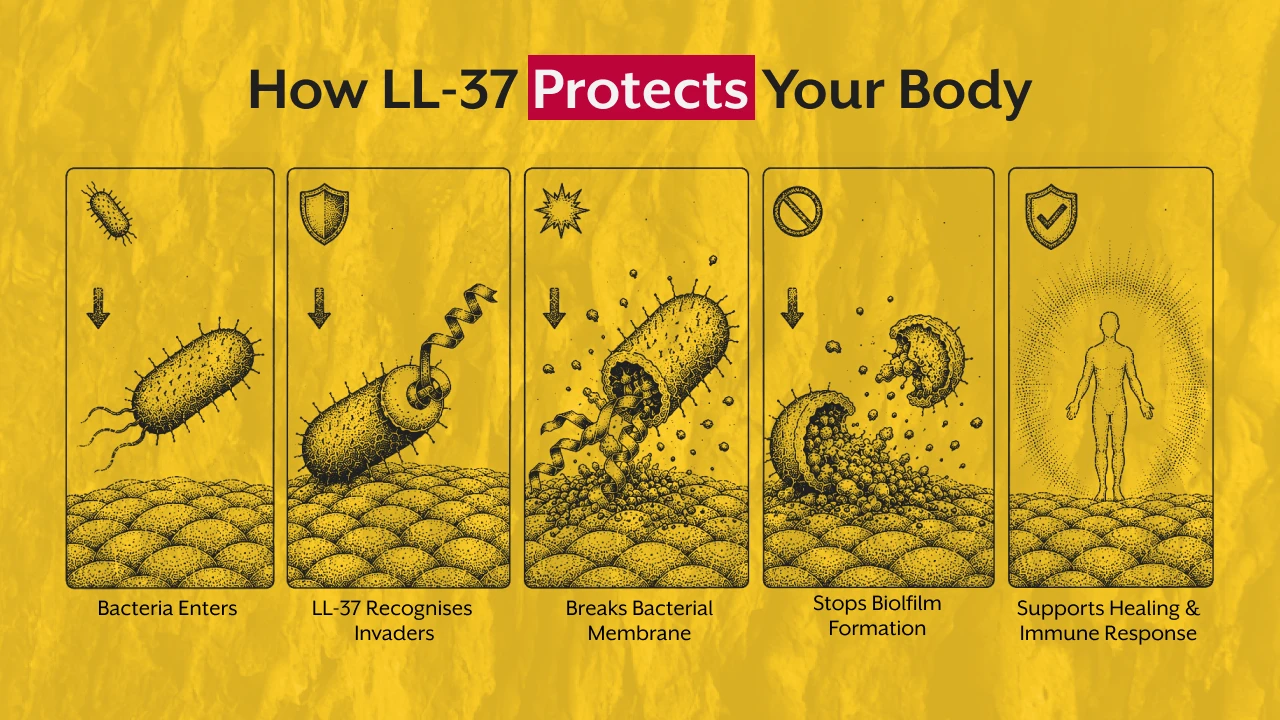
Here’s where it gets interesting. Antibiotics typically work by inhibiting a single function of bacteria (synthesizing cell walls, producing proteins, replicating DNA, etc.). LL-37 takes on a far more brutal approach. It physically destroys the bacterial membrane.
LL-37 has a net positive charge and an amphipathic structure, whereas the cell membranes of bacteria are negatively charged. Therefore, LL-37 gets tightly attached to bacteria, and the peptide inserts itself into the lipid bilayer and disrupts its structure, causing the membrane to leak essential ions and metabolites, leading to rapid cell death. This mechanism is remarkable for one critical reason- bacteria struggle to develop resistance to it. Evolving a fundamentally different membrane structure is enormously difficult; it would compromise too many essential bacterial functions. That is why researchers are interested in LL-37 as a blueprint for new antimicrobials, as antibiotic resistance has become a severe global threat. LL-37 is effective against a wide range of pathogens, including Staphylococcus aureus, Escherichia coli, Pseudomonas aeruginosa, Helicobacter pylori, and various fungi and enveloped viruses.
Falling sick every time the weather changes? These 3 peptides could change the way your immune system responds https://www.ithrivein.com/blog/immunity-peptides-weather-changes-immune-response
The Biofilm Problem and Why LL-37 Matters
Biofilms are one of the most stubborn challenges for modern medicine to treat. They are communities of bacteria that surround themselves with a matrix of proteins, sugars, and DNA. Biofilms hate antibiotics. The matrix physically blocks drug penetration, and bacteria inside biofilms alter their metabolic state in ways that make standard antibiotics far less effective. Chronic wound infections, catheter-associated urinary tract infections, ear infections, and lung infections in cystic fibrosis patients are all biofilm-driven. Biofilms cause infections to become chronic and recur despite treatment. LL-37 has shown a remarkable ability to prevent biofilm formation and degrade existing biofilms. It interferes with the first steps of bacterial attachment to surfaces, and also breaks down the matrix that holds biofilms together. Research on Pseudomonas aeruginosa, a major biofilm-forming pathogen in cystic fibrosis, has shown that LL-37 at physiological concentrations can significantly reduce biofilm thickness and bacterial survival within. Most antibiotics cannot do that. If LL-37 pans out, it could change the way we treat these recalcitrant infections.
Role of LL-37 in Immune Signaling
LL-37 is a potent immunomodulator. LL-37 attracts immune cells to sites of infection, helps heal wounds, and modulates inflammation. It induces cytokine production and stimulates angiogenesis. In skin wounds, LL-37 promotes healing by encouraging keratinocyte migration and proliferation. This peptide also has antiviral properties. It disrupts viral infection of host cells and demonstrates activity against influenza, HIV, herpes simplex virus, and respiratory syncytial virus (RSV). Early in the COVID-19 pandemic, there was some speculation that LL-37 may be involved in altering the host response to SARS-CoV-2 as well, but data on this is still emerging. Most interestingly, LL-37 has anti-endotoxin activity. It binds and neutralizes lipopolysaccharide (LPS), a molecule found on gram-negative bacteria that can cause sepsis. During severe infections, it is often the immune system’s response to LPS that becomes fatal. LL-37 could help clean up LPS while mitigating downstream inflammatory effects.
When LL-37 Goes Wrong
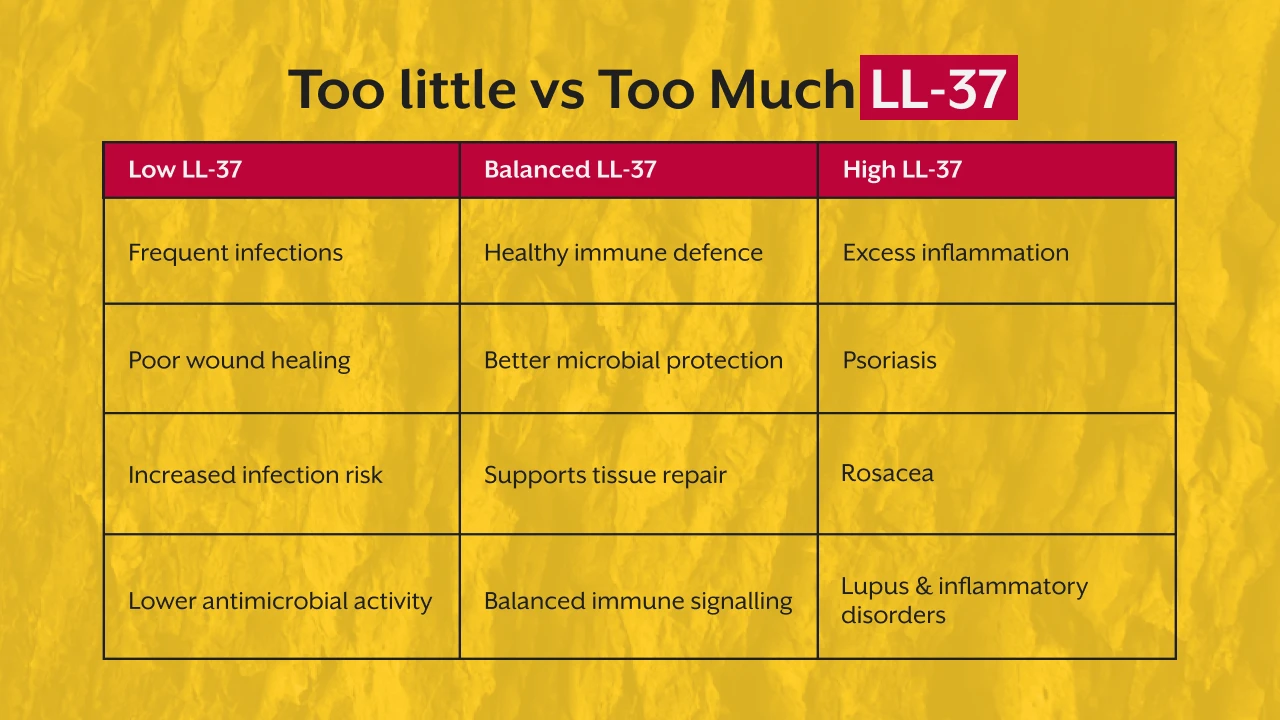
As with any other potent peptide, LL-37 needs to be carefully balanced. Too little and you get infections. Too much and inflammation runs rampant. Deficiency of LL-37 in the body has been linked to susceptibility to infection. Atopic dermatitis (eczema) patients have been found to have significantly less LL-37 in their skin. This may help explain why people with eczema suffer from so many bacterial skin infections. Since vitamin D is a potent stimulator of LL-37 production, this may partially explain the links seen between vitamin D deficiency and increased risk of infections, especially respiratory infections. Too much of LL-37 has also been associated with inflammatory conditions. Psoriasis patients were found to have increased amounts of LL-37 in their skin lesions, and it appears to promote inflammation by activating plasmacytoid dendritic cells and inducing an autoimmune response-like process. Elevated levels have also been detected in patients with lupus, rosacea, and some forms of inflammatory bowel disease. The fact that LL-37 can be both anti-infectious and pro-inflammatory makes it a very interesting target for drug development.
Can You Boost Your LL-37?
Since LL-37 is so important, it is natural to wonder if there are practical ways to promote healthy levels of LL-37. A few more well-studied factors stand out. Vitamin D is the most potent stimulus for LL-37 production that we know of. Adding vitamin D to the diet of deficient individuals results in a significant increase in LL-37 in respiratory cells- one reason why vitamin D is thought to help protect against respiratory infections. Exercise has also been shown to increase the production of antimicrobial peptides including LL-37, likely through a combination of immune activation and improved circulation. Getting enough sleep and managing stress matter too. Chronic stress and lack of sleep are well recognized to suppress the immune system. This perhaps includes host defense peptides like LL-37 too. Butyrate is a short-chain fatty acid produced when certain gut bacteria ferment fiber. It has also been shown to induce LL-37 production by intestinal epithelial cells, adding one good reason to eat your veggies.
While supporting healthy vitamin D levels, gut health, sleep, and stress management may help maintain normal LL-37 production, persistent infections or recurring inflammation often have multiple underlying drivers. If you’re dealing with frequent infections, poor immunity, or chronic inflammatory symptoms, Book your Root Cause Analysis to understand what your body may actually be missing before turning to supplements or peptide therapies.
How is LL-37 peptide administered?
LL-37 peptide is administered subcutaneously, typically in the abdomen, thigh or upper arm. LL-37 comes as a lyophilized (freeze-dried) powder. It is reconstituted with bacteriostatic water before administration. The doses of this peptide range from 100-200 mcg. LL-37 is given 5 days a week with 2 days off for 4 weeks, followed by at least 2 weeks off.
Are there any side effects of LL-37 peptide?
LL-37 is generally considered safe when used for short-term cycles in low doses. The most common side effects of LL-37 peptide include redness, swelling, itching, and irritation at the site of injection. Long-term use or high doses of this peptide, however, have been shown to cause chronic skin inflammation and autoimmune reactions.
The Future: LL-37 as a Drug
Research is underway to develop therapeutics based on the properties of LL-37. However, there are certain challenges. LL-37 can be degraded by bacterial and host proteases, has demonstrated toxicity to host cells at high concentrations, and is costly to synthesize at scale. Synthetic analogs of the peptide, however, have demonstrated real potential in preclinical and early clinical studies. Topical formulations aimed at wound healing, inhaled versions for lung infections, and systemic treatments for sepsis are all being investigated. Antimicrobial peptides, LL-37 among the most well understood, are one of the most exciting frontiers for combating antibiotic resistance.
Key Takeaway
LL-37 is a reminder that the human body is not a passive host waiting for infections to be treated. It is an active and complex battlefield that has been fighting these wars for years. LL-37 neutralizes bacteria, disrupts biofilms, destroys viruses, recruits immune cells, heals wounds, and reduces harmful inflammation. Figuring out how to leverage what LL-37 can do for us could very well be one of the best investments we can make into our future health. In addition, learning more about LL-37 could help develop treatments that outsmart antibiotic resistance once and for all.
References
Yang, B., Good, D., Mosaiab, T., Liu, W., Ni, G., Kaur, J., Liu, X., Jessop, C., Yang, L., Fadhil, R., Yi, Z., & Wei, M. Q. (2020). Significance of LL-37 on Immunomodulation and Disease Outcome. BioMed research international, 2020, 8349712. https://doi.org/10.1155/2020/8349712
Voronko, O. E., Khotina, V. A., Kashirskikh, D. A., Lee, A. A., & Gasanov, V. A. o. (2025). Antimicrobial Peptides of the Cathelicidin Family: Focus on LL-37 and Its Modifications. International Journal of Molecular Sciences, 26(16), 8103. https://doi.org/10.3390/ijms26168103
















.svg)